What Is CE Certification?
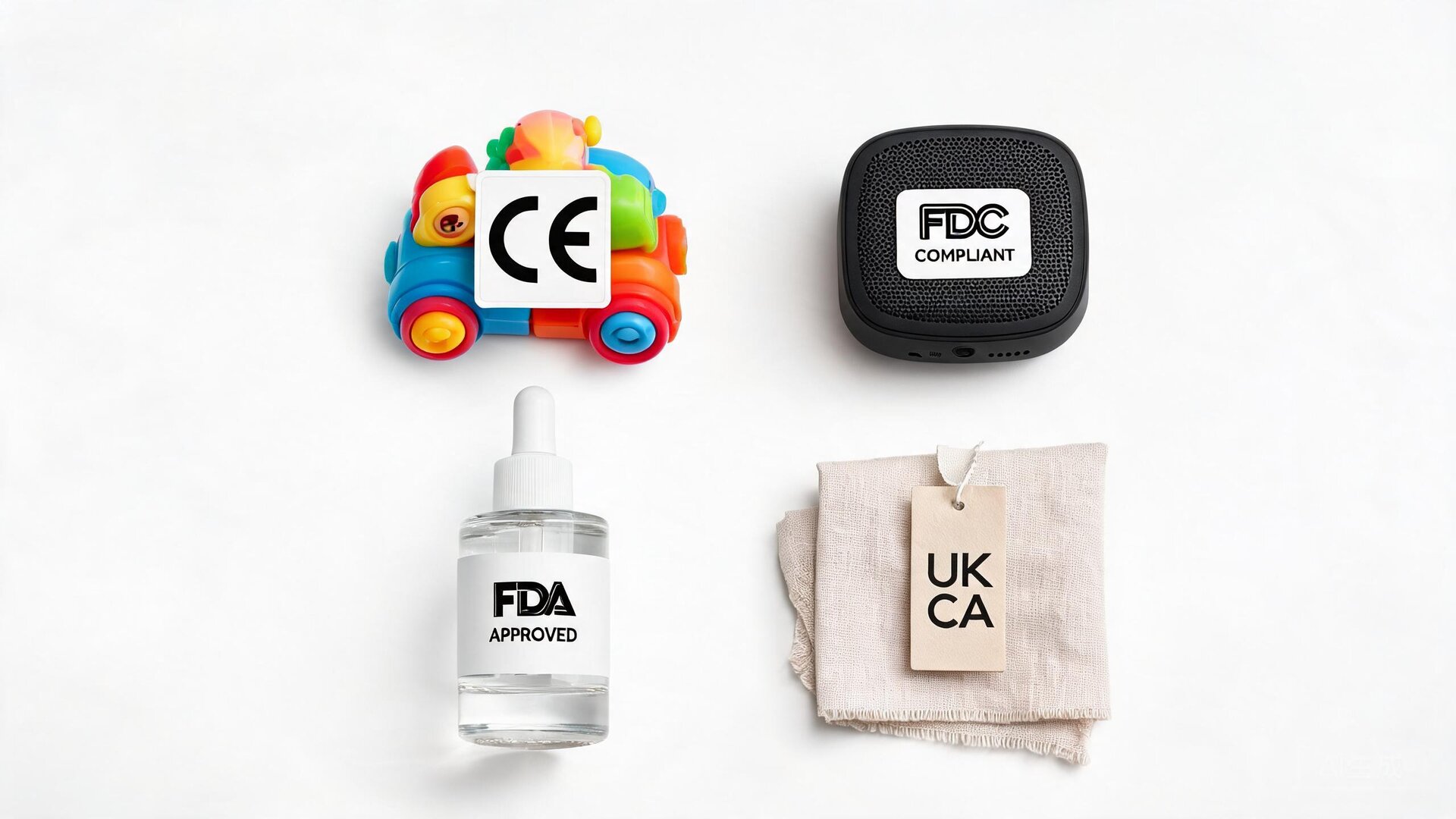
CE marking (Conformité Européenne) is the manufacturer's self-declaration — or, for higher-risk products, a Notified Body's verified confirmation — that a product meets the health, safety, and environmental protection requirements of the applicable EU directives and regulations. It is mandatory for products covered by ~21 EU directives (electronics, toys, machinery, PPE, medical devices, lifts, gas appliances, construction products, ATEX, etc.) before they are placed on the EU market — meaning sold, imported, or given away in any of the 27 EU member states plus the EEA. The mark is not a quality seal; it is the visible pass-key that lets your shipment clear EU customs and stay on the market without being pulled by surveillance authorities. See our broader product certifications guide for how CE compares to FCC, UKCA, CPC, and FDA.
Which EU Directives Apply to Your China-Made Product?
The first step is identifying every directive that applies — missing one is the single most common reason EU customs detains shipments. Below are the directives most relevant to products sourced from China.
| Product Type | Applicable Directives | Key Harmonized Standard | Module |
|---|---|---|---|
| IT / AV equipment (chargers, speakers, routers) | LVD 2014/35/EU · EMC 2014/30/EU · RoHS 2011/65/EU | EN 62368-1 | A (self) |
| Wireless / Bluetooth / Wi-Fi devices | RED 2014/53/EU · LVD · EMC · RoHS | EN 300 328 / EN 301 489 / EN 62368-1 | A (self) + radio spectrum |
| Toys | Toy Safety 2009/48/EC · EN 71 series | EN 71-1/-2/-3 (+ EN 62115 for electric toys) | A (self) |
| Household appliances | LVD · EMC · RoHS · (ErP for energy) | EN 60335-1 + EN 60335-2-XX | A (self) |
| Machinery | Machinery Directive 2006/42/EC | EN ISO 12100 | A (Annex I); B+D for hazardous |
| Personal Protective Equipment (gloves, masks, eyewear) | Reg (EU) 2016/425 | EN 388 / EN 166 / EN 14683 | B+F / B+D (Cat III) |
| Active medical devices | MDR 2017/745 (or IVDR 2017/746) | EN/ISO 13485 + EN 60601-1 | B+D / B+F / H (Notified Body mandatory) |
| Lifts / lift components | Lifts Directive 2014/33/EU | EN 81-20 / EN 81-50 | B+D / G / H |
| Gas appliances | Reg (EU) 2016/426 | EN series per appliance | B+D / B+F / B+E |
| Construction products (cement, doors, hardware) | CPR 305/2011 | EN per product category | AVCP system 3 (Notified Body tests) |
Notice the RoHS directive (2011/65/EU) applies to almost all electronics in addition to LVD/EMC — and the EU's RoHS scope expanded in 2023 to cover categories like cables and spare parts. Pair CE/RoHS with REACH (chemicals) for full chemical compliance on EU-bound consumer goods.
Module A Self-Declaration vs Notified Body — Which Do You Need?
EU conformity-assessment modules range from A (manufacturer self-declaration) through G and H (full Notified Body audit and surveillance). The directive, not the buyer, decides which modules are allowed.
| Module | Who Certifies | Typical Cost (China) | Typical Timeline | Examples |
|---|---|---|---|---|
| A (self-declaration) | Manufacturer or EU importer | $300 – $1,500 (lab tests) | 2 – 6 weeks | Most electronics, toys, IT, lighting |
| Aa2 / Aa1 (technical specs) | Self + lab/Notified Body review | $1,500 – $5,000 | 4 – 8 weeks | Some construction products |
| B (EU-type examination) + D / F | Notified Body | $5,000 – $15,000 | 8 – 16 weeks | PPE Cat III, certain machinery |
| G (unit verification) | Notified Body (per unit) | $8,000 – $25,000 | 10 – 20 weeks | Custom machinery, lifts (rare) |
| H (full QA) | Notified Body surveillance | $10,000 – $25,000+ / yr | 12 – 24 weeks | Active medical devices, PPE Cat III |
For Module A the CE mark contains no 4-digit Notified Body number. For higher-risk modules (B+D, B+F, G, H), the CE mark must carry the 4-digit Notified Body ID — that single number is what EU market surveillance checks first.
Real 2026 CE Certification Costs from China
Below are indicative 2026 ranges based on common product categories sourced through Chinese factories. Prices vary by product complexity, number of variants, and chosen lab.
| Product Category | Lab Test Fees | Notified Body Fees (if required) | Total Range |
|---|---|---|---|
| USB charger / power bank (LVD+EMC+RoHS) | $400 – $900 | Not required | $400 – $900 |
| Bluetooth speaker (RED+LVD+EMC+RoHS) | $1,200 – $2,500 | Not required (Module A) | $1,200 – $2,500 |
| Plastic toy (EN 71-1/-2/-3) | $300 – $700 | Not required | $300 – $700 |
| Kitchen appliance (EN 60335) | $800 – $1,800 | Not required | $800 – $1,800 |
| Face mask (PPE Cat III, EN 14683) | $2,000 – $4,000 | $8,000 – $15,000 | $10,000 – $19,000 |
| Electric massager (medical device, MDR) | $3,000 – $6,000 | $12,000 – $25,000 | $15,000 – $31,000 |
| Garden power tool (MD + LVD + EMC) | $1,500 – $3,000 | Optional $2,500 – $5,000 | $1,500 – $8,000 |
Budget 4–8 weeks for Module A testing and 3–6 months for full Notified Body certification including factory audits. For Amazon EU sellers, plan CE testing before mass production so the DoC is ready when the first container ships.
Worked Example: A Shenzhen Bluetooth Speaker Bound for the EU
A buyer orders 3,000 Bluetooth speakers from a Shenzhen factory, retailing at €39 in Germany. The required compliance stack is RED + LVD + EMC + RoHS + REACH SVHC. Total path:
- Identify directives: RED 2014/53/EU (radio), LVD 2014/35/EU (safety), EMC 2014/30/EU, RoHS 2011/65/EU. Module A applies (RED allows self-declaration).
- Lab tests: Send 3 samples to a CNAS-accredited lab (CTI or CEPREI in Shenzhen) for EN 300 328 (2.4 GHz Wi-Fi/Bluetooth), EN 301 489-17 (EMC), EN 62368-1 (audio safety), EN 62479 (RF exposure). Lab fees: $1,800. Timeline: 4 weeks.
- Build the Technical Documentation File (TCF): Product photos, PCB layout, BOM with supplier declarations for RoHS, RF test reports, user manual in German, packaging/labeling drawings with CE mark, DoC draft. Keep on file for 10 years.
- Issue EU Declaration of Conformity: Buyer (EU importer of record) or Chinese factory signs and dates the DoC listing every directive + harmonized standard. No 4-digit NB number (Module A).
- Affix CE mark on the speaker base, retail box, and user manual. Add WEEE, batch number, manufacturer name + address.
- Ship with DoC + TCF summary in the export docs so EU customs can request on entry.
For 3,000 units at €39 retail, the $1,800 lab fee is €0.62/unit amortized — under 2% of retail. Compare this to the cost of customs detention (~€3,000–€5,000 in brokerage + demurrage) or an Amazon EU listing suspension, and CE certification is the cheapest insurance in the sourcing stack.
Common CE Mistakes That Get Shipments Seized
- Affixing CE without the DoC and TCF — the mark is only the visible tip; the document chain is the actual evidence customs and surveillance want.
- Using a fake or outdated test report — market surveillance routinely cross-checks report numbers against lab databases; mismatches trigger immediate recalls.
- Forgetting RoHS or REACH on electronics — even with valid LVD/EMC reports, missing RoHS 2011/65/EU + REACH SVHC paperwork means customs detention.
- Putting a 4-digit Notified Body number on a Module A product — using a real NB number you didn't earn is fraud and triggers immediate seizure + investigation.
- Not translating the user manual — directives require manuals in the language of each member state where the product is sold; Germany, France, and Italy enforce this strictly.
- Reusing last year's report for a new model — even minor PCB or housing changes invalidate the previous test report; you need a delta-test or full re-test.
- Skipping the importer-of-record DoC — when the factory in China self-declares but the EU importer doesn't co-sign, customs can hold the shipment pending an EU-side declaration.
How to Verify a Chinese Factory's CE Documentation
- Verify the factory first on gsxt.gov.cn — never wire a deposit to an unverified supplier.
- Ask for the test report — it must list the exact model number on your PO and the lab's ISO 17025 / CNAS accreditation number.
- Cross-check the lab — look up the lab on the CNAS or ILAC MRA website; if not listed, the report is worthless.
- Request the DoC draft — it must list every directive and harmonized standard; the signatory must be the EU importer or the manufacturer.
- Spot-check the harmonized standard against the EU OJ (Official Journal) reference list — applying the wrong EN standard invalidates the presumption of conformity.
- Run a pre-shipment QC inspection that confirms CE marking on the product, retail box, and manual — and that the model number on the carton matches the test report.
How Yeatru Handles CE Certification
Yeatru Sourcing runs EU compliance from the China side for Amazon EU, TikTok Shop EU, and wholesale buyers. Our flow:
- Directive mapping in 48 hours — list every applicable EU directive + harmonized standard before sample production starts.
- Lab selection — CTI, CEPREI, or STC in China for Module A; TUV / SGS / Intertek / DEKRA for higher-risk Notified Body work.
- Sample management — we send pre-production samples to the lab, chase reports, and translate the user manual into German / French / Italian / Spanish.
- TCF assembly — BOM, schematics, supplier declarations, packaging drawings, risk assessment, all archived for 10 years.
- DoC drafting + contractual pass-through — the factory or your EU entity signs; the legal chain is bulletproof.
- Pre-shipment inspection confirms the CE mark is on every unit, box, and manual before balance payment.
Frequently Asked Questions
1. How much does CE certification cost in China?
Self-declaration (Module A) for low-risk electronics, toys, and IT costs $300–$1,500 in lab test fees at CNAS-accredited Chinese labs (CTI, CEPREI). Notified Body certification for higher-risk classes (PPE, medical devices, machinery) runs $2,500–$25,000 depending on the directive and audit module.
2. How long does CE certification take from a Chinese factory?
Standard electronics (LVD+EMC+RoHS) testing takes 2–4 weeks. Adding RED for wireless products adds 2–3 more weeks. Toy Safety (EN 71) typically takes 2–3 weeks. Notified Body audits for PPE/MD can take 6–12 weeks because of factory inspections and module reviews.
3. Can a Chinese factory self-declare CE, or does it need a Notified Body?
Most low-risk products (IT, AV, toys, lighting, simple appliances) use Module A self-declaration by the manufacturer or EU importer. Higher-risk classes require a Notified Body: PPE Category III, active medical devices, lifts, gas appliances, certain machinery, and ATEX. The CE mark must include the 4-digit Notified Body number only when one was involved.
4. Will EU customs check the CE mark and Declaration of Conformity?
Yes. EU customs can request the Declaration of Conformity and Technical Documentation File at import. Missing DoC, an invalid CE mark, or test reports that do not match the imported model trigger detention, fines (often 5%–15% of shipment value), or destruction of the goods. Market surveillance authorities can also pull units from Amazon EU warehouses.
5. Is a CE test report from a Chinese lab accepted in the EU?
Yes if the lab is ISO 17025-accredited and tests against harmonized standards. CNAS-accredited Chinese labs like CTI, CEPREI, and STC are widely accepted for Module A self-declaration. EU Notified Bodies (TUV, SGS, Intertek, DEKRA) issue reports that are required for higher-risk classes and tend to face fewer market surveillance challenges.
6. Do I need separate CE marks for each EU country?
No. CE marking is EU-wide and valid in all 27 member states plus the EEA (Norway, Iceland, Liechtenstein). One DoC listing every applicable directive lets you sell across the entire bloc. The UK now requires separate UKCA marking — see that guide for the post-Brexit rules.
Conclusion
CE certification is the price of admission for selling China-made products in the EU market, and the difference between a clean customs clearance and a detained shipment usually comes down to whether the DoC, TCF, and harmonized-standard test reports are assembled correctly and travel with the cargo. For most low-risk electronics, toys, and appliances, Module A self-declaration at $300–$1,500 is enough — provided your Chinese lab is ISO 17025 / CNAS-accredited and the model number on the report matches the carton. For PPE, medical devices, lifts, and gas appliances, budget for a Notified Body at $2,500–$25,000 and 3–6 months of lead time. Pair CE with RoHS, REACH, and a pre-shipment QC that confirms the mark is on every unit. Get a free CE compliance review from Yeatru — we'll map the directives, pick the lab, draft the DoC, and inspect the shipment before balance payment.