What Are Product Certifications?
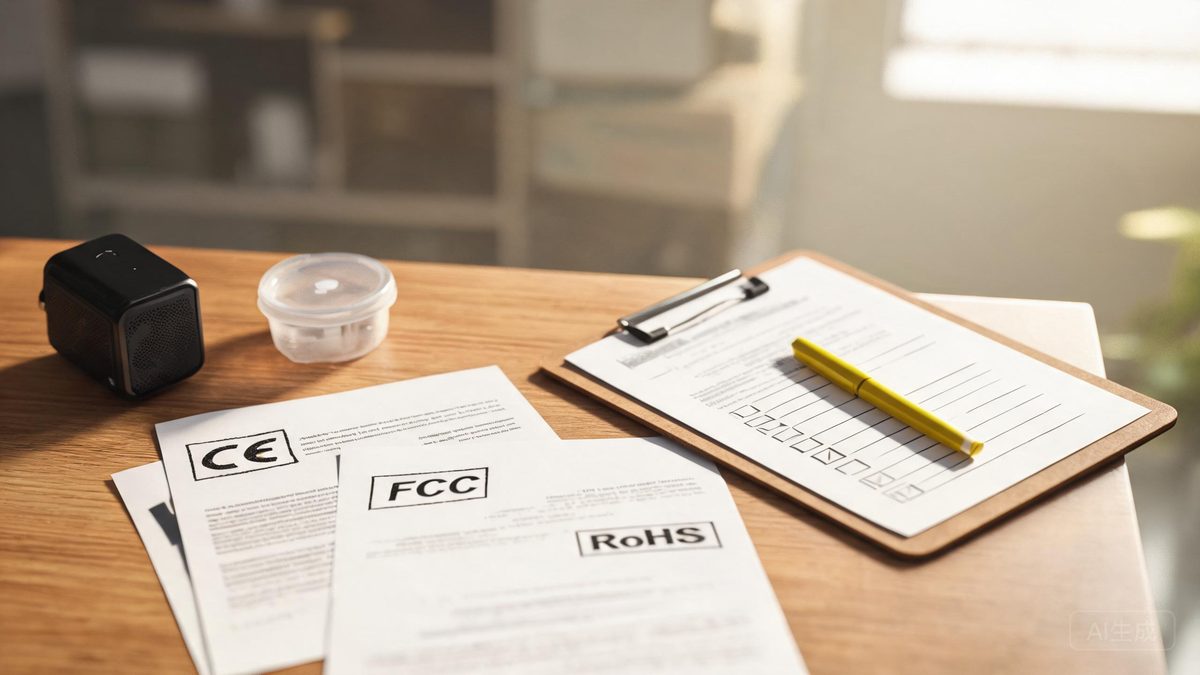
Product certifications are the legal documents and test reports that prove a product meets the safety, health, and environmental rules of the market where it is sold. When you source from China, the factory may hold certificates, but the legal responsibility for compliance usually sits with the importer (you) in the EU and the manufacturer/importer in the US. Getting certifications wrong means a seized shipment at customs, a marketplace delisting (Amazon, TikTok), or a product recall. The big four for importers are CE (EU), FCC (US electronics), RoHS (hazardous substances), and FDA (food, drugs, medical, cosmetics). See also product compliance inspection and food contact materials.
Category-to-Certification Table
| Product | EU | United States | China (domestic) |
|---|---|---|---|
| Electronics (no radio) | CE (LVD + EMC) + RoHS + WEEE | FCC SDOC + state RoHS | CCC (if on CCC list) + GB |
| Electronics (with radio: BT, WiFi) | CE (RED) + RoHS + WEEE | FCC Certification (FCC ID) | SRRC + CCC + NAL |
| Toys (children's) | CE (Toys Dir. EN71) + REACH | CPSC + CPSIA (lead/phthalates) + CPC | GB 6675 + CCC |
| Food-contact materials | EU 1935/2004 + EU 10/2011 | FDA 21 CFR 175-189 | GB 4806 series |
| Cosmetics | Reg. 1223/2009 (CPNP) | FDA (registration, labeling) | NMPA registration |
| Medical devices | MDR 2017/745 (CE) | FDA 510(k) / PMA | NMPA |
| Apparel / textiles | REACH + textile labeling | FTC labeling + CPSIA (children's) | GB 18401 |
CE Marking (European Union)
CE marking is the EU's conformity marking. It is a self-certification regime: the manufacturer (or importer, if the manufacturer is outside the EU) draws up a Declaration of Conformity (DoC), maintains a technical file, and affixes the CE mark. For electronics, the relevant directives are LVD 2014/35/EU (electrical safety) and EMC 2014/30/EU (electromagnetic compatibility). For wireless devices, the RED 2014/53/EU replaces LVD/EMC. The CE mark must be on the product, and you must keep the DoC and technical file for 10 years. Note: CE is not a test certificate — it is a declaration backed by test reports from an accredited lab (or, for some categories, a Notified Body assessment).
FCC (United States)
The US Federal Communications Commission regulates electronic products' radiofrequency emissions. There are two paths:
- SDOC (Supplier's Declaration of Conformity) — for unintentional radiators (e.g., a USB charger, a lamp). The importer tests to FCC Part 15B and issues a self-declaration. Cost: $500–$2,000.
- Certification (FCC ID) — for intentional radiators (Bluetooth, WiFi, remote controls). Requires testing by an FCC-recognized lab and an FCC grant. Cost: $2,000–$10,000+.
The FCC ID must be on the product. Amazon requires FCC documentation for many electronics listings.
RoHS (Restriction of Hazardous Substances)
RoHS restricts 10 hazardous substances in electrical and electronic equipment: lead, mercury, cadmium, hexavalent chromium, PBB, PBDE, and four phthalates (DEHP, BBP, DBP, DIBP). The EU's RoHS 2011/65/EU is mandatory for electronics sold in the EU. The US has no federal RoHS, but California and a few other states enforce similar restrictions. A RoHS test report costs $150–$600 per material/component set. Many buyers combine RoHS with CE testing.
FDA (Food, Drugs, Medical, Cosmetics)
The US FDA regulates food, drugs, medical devices, cosmetics, and tobacco. The requirements vary wildly:
- Food & beverages: facility registration (FSMA), prior notice of import, and labeling compliance. No pre-approval for most foods.
- Food-contact materials: compliance with FDA 21 CFR Parts 175–189 (see food contact materials).
- Drugs: FDA drug approval (lengthy and expensive).
- Medical devices: Class I = registration only; Class II = 510(k) ($10,000+ user fee + consulting); Class III = PMA.
- Cosmetics: facility registration and product listing (MoCRA as of 2023), plus ingredient and labeling rules.
CPSC / CPSIA (US Children's Products)
Children's products (intended for children 12 and under) sold in the US must comply with CPSIA: limits on lead (100 ppm in paint, 90 ppm for paint) and phthalates (DEHP, DBP, BBP restricted), plus mandatory third-party testing for certain categories. You must issue a Children's Product Certificate (CPC) and include tracking labels. Toys also need ASTM F963 testing. Cost: $300–$1,500 for EN71/ASTM testing.
CCC (China Compulsory Certification)
CCC is China's mandatory certification for products sold within China (electrical appliances, toys, automotive parts, safety glass, etc.). CCC is not required for products exported from China. If you are importing from China to the EU or US, you do not need CCC — you need the destination market's certifications (CE, FCC, etc.). Many buyers confuse this: a factory holding CCC means it can sell in China, not that your product is compliant in the EU/US.
Certification Costs & Timeline
| Certification | Cost | Timeline | Notes |
|---|---|---|---|
| RoHS test report | $150 – $600 | 3–7 days | Per material/component set |
| FCC SDOC | $500 – $2,000 | 1–2 weeks | Unintentional radiators |
| FCC Certification (FCC ID) | $2,000 – $10,000+ | 4–8 weeks | Intentional radiators (BT/WiFi) |
| CE (LVD+EMC) | $1,000 – $5,000 | 2–4 weeks | + DoC & technical file |
| CE RED (wireless) | $3,000 – $10,000 | 4–8 weeks | Notified Body for some |
| EN71 / ASTM F963 (toy) | $300 – $1,500 | 1–2 weeks | + CPC (US) |
| FDA 510(k) | $10,000+ (user fee) + consulting | 3–6 months | Class II medical devices |
| CCC (China domestic) | $1,000 – $5,000 | 2–4 months | Only for China sales |
Worked Example: Bluetooth Speaker to the EU & US
A buyer sourced a Bluetooth speaker from a factory in Shenzhen. The factory quoted $8.50/unit EXW for 5,000 units, with existing CE and FCC test reports for model BT-200. The buyer's product was the same model but with a custom logo and a different battery supplier. Because the battery changed (a safety-critical component), the buyer could not rely on the factory's existing test reports. Testing costs:
- CE RED (wireless safety + EMC + RF): $4,500 (new battery = retest)
- FCC Certification (FCC ID, intentional radiator): $3,800
- RoHS test report: $350
- Total testing: $8,650 (one-time, valid for the model)
Spread over 5,000 units, testing added $1.73/unit — bringing the landed cost from $8.50 to $10.23/unit before freight and duty. The buyer negotiated the unit price down to $8.00 by committing to 10,000 units over 12 months, partially offsetting the testing cost. The DoC, technical file, and FCC grant were filed before shipment, and the CE and FCC ID marks were printed on the product.
How to Verify a Certificate
- Get the certificate and test report. A factory saying "we have CE" is not enough — demand the actual document.
- Check the issuing body. Accredited labs (SGS, Intertek, BV, TUV) and Notified Bodies (for CE) have online verification portals.
- Verify the certificate number and expiry date. Enter the number on the lab's website. Fake certificates often have invalid numbers.
- Confirm it covers your exact product. Same model, materials, components. A certificate for model A does not cover model B.
- Confirm it covers your destination. A CE certificate is for the EU, not the US. An FCC grant is for the US, not the EU.
Common Red Flags
- Factory refuses to share the actual certificate (only "we have it").
- Certificate is from an unknown lab with no online verification.
- Certificate expired or covers a different model.
- "CE certificate" from a Chinese lab that is not a Notified Body (for self-certified products this is OK, but verify the test lab is accredited).
- FCC ID that doesn't exist in the FCC ID database.
How Yeatru Helps
- Identify the required certifications for your product and destination before you place an order.
- Verify the factory's existing certificates (number, expiry, model coverage) on the issuing body's website.
- Arrange accredited-lab testing for your exact product/materials if existing certificates don't cover it.
- Collect the DoC, test reports, and technical file for your records.
- Confirm correct marking (CE, FCC ID, RoHS, WEEE) on the finished product before shipment.
Frequently Asked Questions
1. What certifications do I need to import from China to the EU?
For the EU, most products need CE marking based on the applicable directive: electronics need CE (LVD 2014/35/EU + EMC 2014/30/EU) + RoHS 2011/65/EU + WEEE; toys need CE (Toys Directive 2009/48/EC, EN71); food contact materials need EU 1935/2004 + material-specific rules; cosmetics need Regulation 1223/2009. You also need a Declaration of Conformity and a technical file kept for 10 years.
2. What certifications do I need to import from China to the US?
For the US: electronics need FCC (SDOC for unintentional radiators, Certification for intentional transmitters) + state-level RoHS; children's products need CPSC + CPSIA (lead & phthalates) + a Children's Product Certificate (CPC); food/drugs/medical devices need FDA registration/listing; food-contact materials need FDA 21 CFR compliance. The US does not have a single CE-equivalent mark.
3. What is the difference between CE, FCC, and RoHS?
CE is the EU's conformity marking covering safety (LVD), electromagnetic compatibility (EMC), and product-specific directives. FCC is the US requirement for electronic products' radiofrequency emissions (SDOC or Certification). RoHS restricts hazardous substances (lead, mercury, cadmium, hexavalent chromium, PBB, PBDE, and four phthalates) in electronics and is enforced in the EU and several US states.
4. How much do product certifications cost?
Costs range widely: RoHS test report $150–$600; FCC SDOC $500–$2,000; FCC Certification (intentional radiator) $2,000–$10,000+; CE LVD+EMC test $1,000–$5,000; EN71 toy testing $300–$1,500; FDA establishment registration is free but 510(k) for medical devices is $10,000+ (user fee) plus consulting. Always get a quote from an accredited lab.
5. Can I use the Chinese factory's existing certificate?
Sometimes. A factory's certificate covers their exact tested model. If your product is identical (same model, materials, components) you can rely on it with the factory's authorization letter. If you changed anything (logo, color, material, component supplier), you need a new test or at minimum a difference assessment. Always verify the certificate is current and authorized for your product.
6. What is CCC and when is it required?
CCC (China Compulsory Certification) is China's mandatory certification for products sold IN the Chinese market, covering categories like electrical appliances, toys, automotive parts, and safety glass. CCC is NOT required for products exported from China to the EU/US. If you only import FROM China, you do not need CCC; you need the destination market's certifications (CE/FCC/etc.).
Conclusion
Product certifications for importing from China depend on the product category and the destination market: CE (EU), FCC (US), RoHS, FDA, CPSC, and CCC (China domestic only). Budget $150–$10,000+ for testing, verify every certificate on the issuing body's website, and don't assume a factory's existing certificate covers your custom product. Getting certifications right prevents seized shipments and recalls. Ask Yeatru to map your product to the required certifications before you place an order.