What Is Private Label Beauty from China?
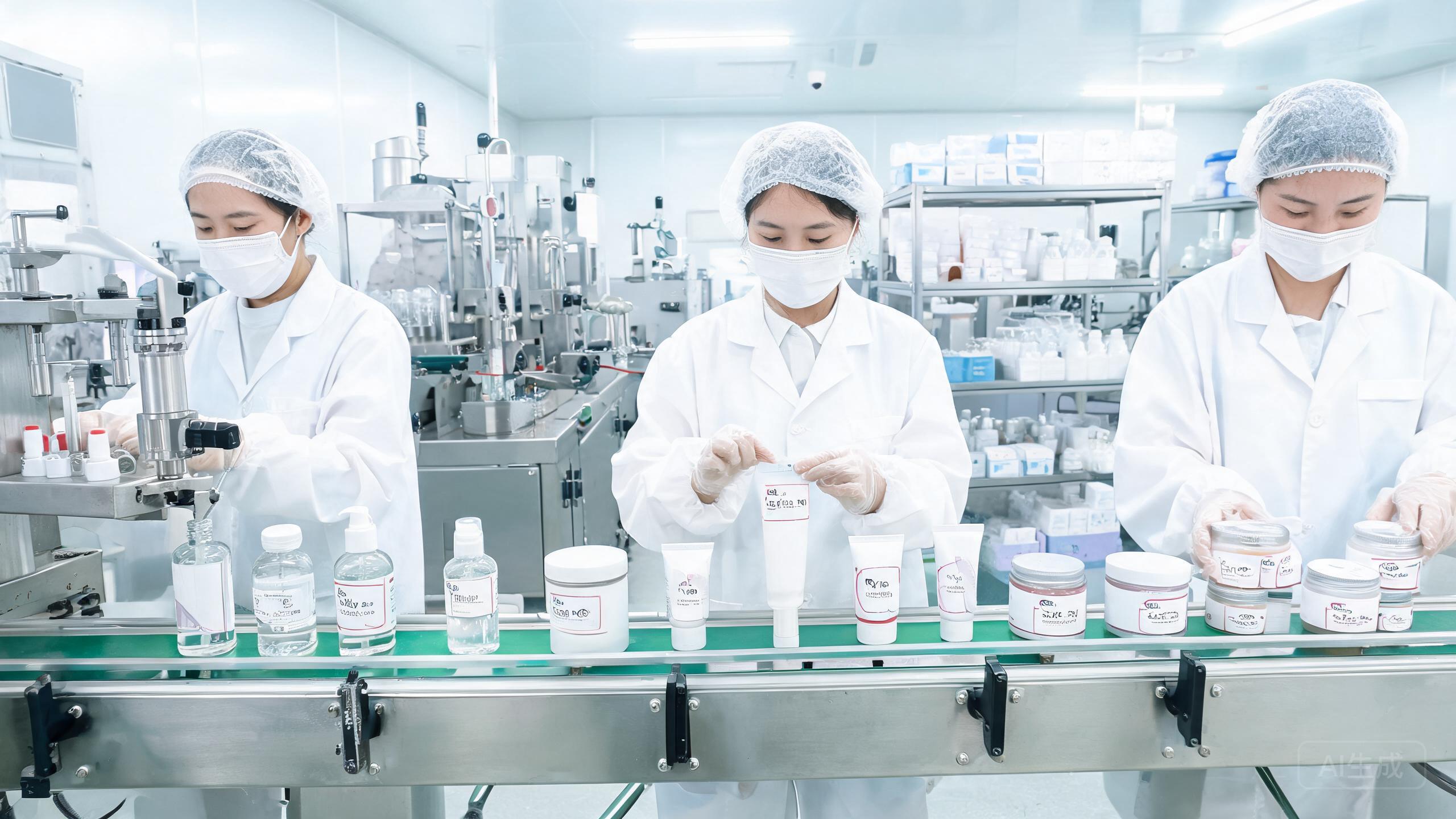
Private label beauty (also called cosmetics OEM or white-label skincare) means a Chinese factory manufactures a product — serum, lipstick, shampoo, makeup brush — and labels it with your brand. You choose the formula (or provide your own), packaging, color, scent, and logo; the factory handles production, filling, and assembly. China accounts for roughly 40% of global beauty OEM output, with clusters in Guangzhou, Shanghai, and Yiwu that cover every category from skincare to color cosmetics to beauty tools.
China Beauty OEM Hubs by Category
Not all Chinese beauty factories make everything. Each hub has a historical specialty, and sourcing from the wrong cluster typically costs you 20–40% more and lowers quality. The table below maps category → hub → typical MOQ → unit cost → lead time.
| Category | Main Hub | MOQ (pcs/SKU) | Unit Cost (EXW) | Lead Time |
|---|---|---|---|---|
| Skincare (serum, cream, mask, cleanser) | Guangzhou (Baiyun district) | 300 – 1,000 | $1.20 – $6.00 | 30 – 45 days |
| Color cosmetics (lipstick, foundation, eyeshadow) | Guangzhou (Huadu) & Shanghai | 1,000 – 5,000 | $0.80 – $4.50 | 35 – 50 days |
| Haircare (shampoo, conditioner, hair oil) | Guangzhou & Yiwu | 500 – 2,000 | $0.60 – $3.20 | 25 – 40 days |
| Beauty tools (jade roller, Gua Sha, brushes, eyelash curler) | Yiwu | 500 – 2,000 | $0.30 – $2.50 | 20 – 35 days |
| Nail products (gel polish, nail art) | Guangzhou & Yiwu | 1,000 – 3,000 | $0.40 – $1.80 | 25 – 40 days |
Guangzhou is the default for skincare and makeup — its Baiyun district alone hosts over 1,000 factories with filling lines and in-house R&D. Shanghai suits premium skincare where formula sophistication and GMPC certification matter. Yiwu wins on beauty tools, accessories, and packaging thanks to its small-commodity supply chain.
Formula Development: In-House vs Custom
Your biggest early decision is whether to use the factory's ready-made formula or develop a custom one.
- In-house / stock formula — the factory's own R&D formula, usually free once you meet the MOQ. Sampling takes 3–7 days. Best for fast launches and price-sensitive buyers; the downside is that dozens of brands may sell an identical formula.
- Custom formula — developed by an independent cosmetics lab to your spec (e.g., "20% vitamin C serum with hyaluronic acid"). Lab fee $500–$2,000, development 2–4 weeks, plus stability and compatibility testing. Best for brands that need a differentiated hero product.
Rule of thumb: use in-house formulas for your first 1–2 SKUs to validate the market, then invest in a custom formula once you have sales data. A custom formula is also easier to defend against copycats.
Compliance: FDA (US) & CPNP (EU)
Cosmetics are regulated in every major market, and non-compliance means seizure at customs or a forced recall. The core requirements are:
| Market | Key Requirement | Typical Cost | Timeline |
|---|---|---|---|
| USA (FDA) | Facility registration + product listing (MoCRA), ingredient listing, responsible person | $300 – $1,500 | 2 – 4 weeks |
| EU (CPNP) | CPNP notification, INCI labeling, safety report (CPSR), EU responsible person | $800 – $3,000 | 2 – 6 weeks |
| China domestic (NMPA) | NMPA cosmetic registration (special cosmetics) or filing (general cosmetics) | $2,000 – $8,000 | 2 – 6 months |
Every batch needs INCI labeling (International Nomenclature of Cosmetic Ingredients), stability testing (typically 3 months accelerated), microbial testing, and heavy-metal limits — lead ≤ 10 ppm, arsenic ≤ 2 ppm, mercury ≤ 1 ppm under EU Regulation 1223/2009. For cross-category certification context, see product certifications from China.
Worked Example: Private-Label Vitamin C Serum
Let's land a 1,000-unit private-label 20% vitamin C serum (30 ml) into the US.
- Formula: factory in-house 20% vitamin C + hyaluronic acid serum — free with MOQ
- Bulk fill + primary glass bottle with dropper: $3.50/pc × 1,000 = $3,500
- Custom silk-screen logo on bottle: $0.10/pc × 1,000 = $100
- Secondary box + label: $0.50/pc × 1,000 = $500
- Stability + microbial testing batch: $400
- FDA facility registration & product listing: $500
- Sea freight DDP to US (≈ 150 kg): $1.50/kg × 150 = $225
- US duty (cosmetics, ~3%): ≈ $120
Total landed ≈ $5,345 for 1,000 units → $5.35/unit. Selling at $24.99 on Amazon gives a gross margin of ~78% before Amazon fees and advertising. A pre-shipment inspection ($180) catches label or fill-weight issues before the container sails.
Packaging & Branding Costs
Packaging often equals or exceeds the product cost in beauty. Budget for both layers:
- Primary packaging — bottle, jar, tube that touches the product. Stock shapes $0.30–$2.00/pc; a custom mold costs $1,000–$5,000 (amortized over 5,000–10,000 pcs).
- Secondary packaging — outer box, insert, label. $0.20–$0.80/pc depending on material and printing.
- Branding decoration:
- Silk-screen printing: $0.05–$0.15/pc (best for 1–2 colors on glass/plastic)
- Hot-stamp (foil): $0.10–$0.25/pc (premium metallic look)
- Adhesive label: $0.05–$0.10/pc (cheapest, good for multi-color)
How Yeatru Manages Beauty OEM
At Yeatru, we run beauty OEM programs for Amazon FBA, DTC, and wholesale brands. Our process covers:
- Factory matching across Guangzhou, Shanghai, and Yiwu based on category and MOQ — no trading-company markup.
- Formula review: we compare in-house vs custom options and vet lab reports (stability, microbial, heavy metals).
- Compliance filing support: FDA registration, CPNP notification, INCI label proofreading, and CPSR coordination.
- Packaging consolidation: we source primary and secondary packs from matched suppliers to cut lead time by 1–2 weeks.
- Final AQL 2.5 inspection with photo/video before the balance payment is released.
For a fuller picture of the OEM workflow, read how OEM private label works in China and how to price private label packaging.
Frequently Asked Questions
1. Can I private label beauty products from China?
Yes. China is the world's largest beauty OEM hub. Guangzhou alone has 1,000+ skincare and makeup factories, Shanghai leads premium skincare R&D, and Yiwu dominates beauty tools and packaging. Most factories offer full private-label service from formula to packaging to logo printing.
2. What is the typical MOQ for beauty OEM in China?
MOQ varies by category: skincare (serum, cream, mask, cleanser) 300–1,000 pcs/SKU; lipstick and color cosmetics 1,000–5,000 pcs; makeup brushes and beauty tools 500–2,000 pcs. Lower MOQs are possible for stock formulas or when combining SKUs.
3. How much does a custom skincare formula cost?
A factory's in-house formula is usually free once you meet the MOQ (3–7 days to sample). A fully custom formula from an independent lab costs $500–$2,000 in lab fees and takes 2–4 weeks, including stability and compatibility testing.
4. Do I need FDA registration to import cosmetics from China to the US?
Yes. US cosmetic facility registration and product listing are required under FDA MoCRA. You also need an INCI ingredient declaration, batch records, and a responsible person. For the EU, file CPNP notification and comply with Regulation 1223/2009.
5. How much does beauty packaging and logo printing cost?
Primary packaging (bottle, jar, tube) runs $0.30–$2.00/pc; a custom mold adds $1,000–$5,000. Logo decoration: silk-screen $0.05–$0.15/pc, hot-stamp $0.10–$0.25/pc, adhesive label $0.05–$0.10/pc. Secondary boxes add $0.20–$0.80/pc.
6. What is the lead time for private label beauty from China?
Total lead time is 30–60 days: formula development or sample approval 2–4 weeks, production 3–4 weeks, and packaging/assembly 1 week. Adding a custom mold extends it by another 2–3 weeks. Plan 8–12 weeks for a first custom order.
Common Pitfalls to Avoid
- No written mold/drawing ownership contract. By default Chinese law treats the factory as the mold owner. Your contract must state you own the mold, drawings, and tooling upon full payment, with retrieval rights.
- Signing no NDA before sharing designs. A factory can legally sell your custom design to competitors if there's no NDA. Sign before sending any CAD files, samples, or spec sheets.
- Approving production without a signed golden sample. A verbal 'looks good' leads to 5,000 units that don't match your expectation. Sign and retain a golden sample; production must match it exactly.
- No MOQ flexibility in the contract. A 5,000-unit MOQ for your first order is risky. Negotiate a 1,000–2,000 trial MOQ at a slightly higher unit price, then scale up after quality is confirmed.
- Skipping IP registration in China. Register your trademark and design patent in China (not just your home country). Chinese trademark law is first-to-file — a factory or competitor can squat your brand if you don't register first.
Conclusion
Private-label beauty from China gives brands access to the world's deepest cosmetics OEM supply chain — but success depends on matching the right hub to your category, locking MOQ and lead time early, and never skipping FDA/CPNP compliance. With skincare MOQs as low as 300 pcs and lead times of 30–60 days, a first launch is achievable on a modest budget. The vitamin C serum example shows a landed cost of ~$5.35 selling at $24.99 — healthy margins when formula, packaging, and compliance are handled correctly. Request a free beauty OEM quote and we'll match you to Guangzhou, Shanghai, or Yiwu factories within 24 hours. Related: private mold vs logo printing.