What Is FDA Import Compliance?
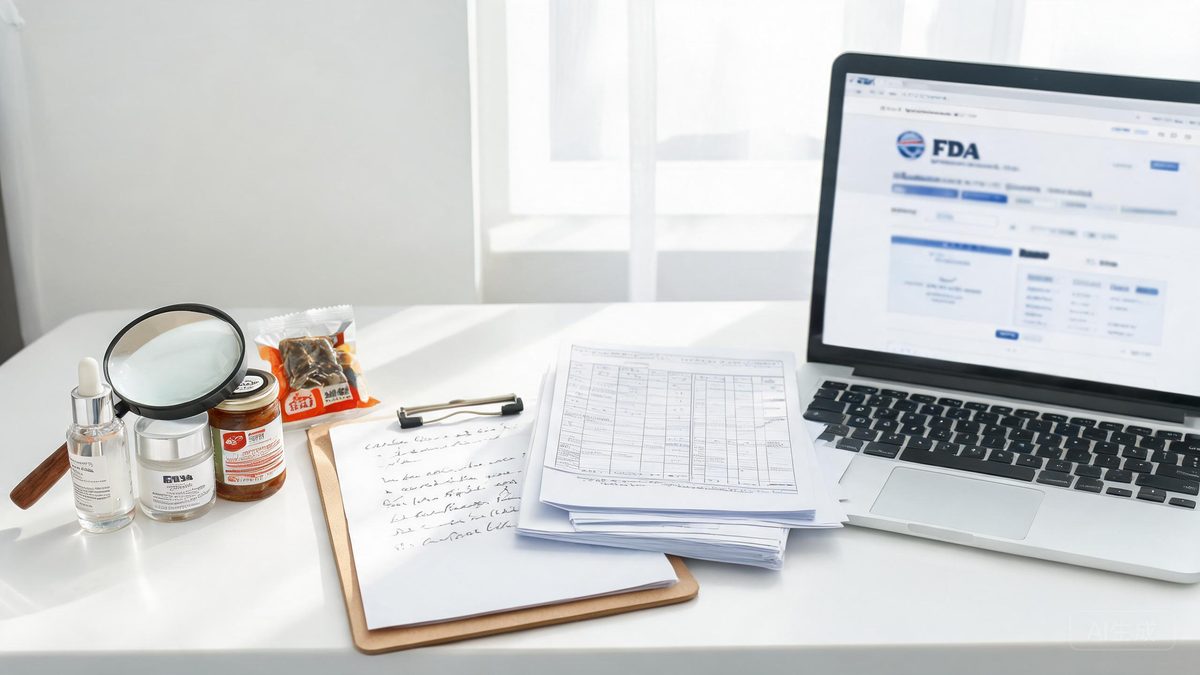
FDA import compliance is the set of U.S. Food and Drug Administration requirements that apply to food, drugs, cosmetics, dietary supplements, medical devices, and tobacco products entering the United States — including those manufactured in China. Unlike a single certification mark (such as CE or FCC), FDA compliance is a process: the foreign facility must be registered, each food shipment requires prior notice, the product must meet substance and labeling standards, and the importer must keep records for FDA inspection. For most consumer-goods importers from China, the relevant FDA centers are CFSAN (Center for Food Safety and Applied Nutrition) for food and food-contact materials, and CDER/CDRH for drugs and devices. Enforcement happens at U.S. ports of entry through detention without physical examination (DWPE) and physical sampling.
FDA-Regulated Product Categories from China
Not every product imported from China falls under FDA — but if it touches food, the body, or claims a health benefit, it likely does. Here is how the main categories map to FDA requirements.
| Product Category | FDA Center | Key Requirement | Documentation |
|---|---|---|---|
| Food (human & animal) | CFSAN | Facility registration + prior notice + FSMA preventive controls | FFR number, PN confirmation, supplier audit |
| Food-contact materials | CFSAN | 21 CFR 174–189 migration compliance | Migration test report, FCM declaration |
| Cosmetics | CDER (OVC) | MoCRA registration, adverse-event reporting, U.S. RP | CPIS registration, SRP name, ingredient list |
| Dietary supplements | CDER | cGMP 21 CFR 111, DSHEA labeling | cGMP audit, certificate of analysis, label review |
| Medical devices | CDRH | 510(k) or PMA, establishment registration | 510(k) clearance, device listing |
| Drugs (OTC & Rx) | CDER | NDANDA, GMP, drug listing | NDA/ANDA approval, DMF |
Kitchenware, drinkware, and baby bottles are the most common FDA-regulated products sourced from Yiwu — see food-contact materials compliance for a category deep dive.
Food Facility Registration & Prior Notice
For food imports, the two non-negotiable administrative steps are facility registration and prior notice filing.
- Food Facility Registration (FFR) — Every foreign facility that manufactures, processes, packs, or holds food for consumption in the U.S. must register with FDA (21 CFR 1, Subpart H). Registration is free and must be renewed every even-numbered year. The U.S. Agent must be a resident of the United States.
- Prior Notice (PN) — For every food shipment, the importer, broker, or carrier must file prior notice with FDA before the food arrives in the U.S. The minimum filing windows depend on the mode of transport.
| Mode of Transport | Minimum Prior Notice Before Arrival |
|---|---|
| By air | 2 hours before arrival |
| By rail | 4 hours before arrival |
| By sea | 8 hours before arrival |
| By road (truck) | 2 hours before arrival |
| By mail/international mail | At time of mailing |
Both FFR and PN are submitted through the FDA PNS (Prior Notice System Interface) or via ACE (Automated Commercial Environment) used by customs brokers. A missing or late PN results in FDA refusal and the shipment being held or returned.
Food-Contact Materials: 21 CFR 174–189 Migration Tests
Products intended to come into contact with food (silicone spatulas, stainless steel water bottles, melamine plates, bamboo bowls, non-stick pans) must comply with 21 CFR Parts 174–189, which set specific migration limits (SML) and overall migration limits (OML) for substances that may transfer from the material into food.
| Material | 21 CFR Reference | Test Simulant | Limit |
|---|---|---|---|
| Silicone rubber | 21 CFR 177.2600 | Distilled water, n-heptane | Residue ≤ 0.5 mg/in² |
| Melamine-formaldehyde | 21 CFR 177.1460 | Water, 3% acetic acid, 8% ethanol | Melamine within SML |
| Stainless steel | 21 CFR 175.300 / 178.3800 | 4% acetic acid (boiling) | Cr, Ni, Pb within limits |
| Polyethylene (PE) | 21 CFR 177.1520 | Water, n-heptane | Extractives ≤ limits |
| Non-stick coating (PTFE) | 21 CFR 177.1550 | Distilled water, n-heptane | ≤ 0.020 mg/in² |
| Bamboo / wood | 21 CFR 178.3800 | Water, 8% ethanol | Extractives limit |
Migration tests are run by FDA-recognized or ISO 17025-accredited labs (SGS, Intertek, Bureau Veritas, Eurofins) in China. A single-material migration test costs $300–$800; a full kitchenware set with multiple materials can run $1,200–$2,500 and take 7–14 business days.
Worked Example: Silicone Food Container Fails Migration Test
A U.S. Amazon seller imports 8,000 silicone food-storage containers (set of 3, $1.80 EXW each) from a Shenzhen factory. The factory claims "FDA-grade silicone" but provides no test report. The seller runs a 21 CFR 177.2600 migration test at SGS Shenzhen before mass shipment.
Test result: n-heptane extractables measured at 0.82 mg/in² — above the 21 CFR 177.2600 limit of 0.5 mg/in².
- Root cause: factory used a low-cost silicone with excess plasticizer and filler
- Migration test cost: $650 for 2 simulants, 7-day turnaround
- Reformulation: switch to food-grade LSR (liquid silicone rubber) with FDA-compliant curing agent
- Reformulation cost increase: +$0.22/unit = $1,760 for 8,000 units
- Re-test cost: $650
- Without the test: FDA detention at LAX, $250–$500/day storage, plus Amazon listing suspension and potential recall
The seller approved the reformulation, re-tested (passed at 0.21 mg/in²), and shipped. Total added compliance cost: $2,410 — far less than the estimated $30,000+ in detention, storage, and lost Amazon rank. See also Amazon restricted products for platform-specific rules.
Top FDA Detention Reasons for Chinese Imports
FDA publishes Import Alerts naming products and countries with a history of violations. China is frequently listed for the following categories, which trigger detention without physical examination (DWPE):
| Detention Reason | Typical Product | FDA Basis |
|---|---|---|
| Salmonella / microbial contamination | Dried seafood, spices, herbal tea | 21 CFR 110 (GMP); adulterated food |
| Pesticide residue | Frozen vegetables, fruit, tea | Tolerance violations (40 CFR 180) |
| Filth (insects, rodent, mold) | Nuts, grains, dried fruit | Defect action levels (DAL) |
| Labeling violations | All food categories | Missing allergen, wrong nutrition facts |
| Unauthorized additives | Food color, preservatives | 21 CFR 70–80 (food additives) |
| Melamine migration | Melamine tableware | 21 CFR 177.1460 |
Labeling is the #1 avoidable rejection. Under the FASTER Act of 2021, sesame became the 9th major food allergen and must be declared on the label. Misbranded food is refused even if the product itself is safe.
Cosmetics, Supplements & Devices: What You Actually Need
For non-food FDA-regulated products, the requirements differ significantly.
- Cosmetics (MoCRA 2022) — Since December 2023, cosmetic facilities must register in CPIS and each product must have a U.S. Responsible Person (SRP). Ingredient labeling and adverse-event reporting are mandatory. No pre-approval is needed, but products containing prohibited ingredients (e.g. mercury in skin lighteners) or restricted color additives are refused.
- Dietary supplements (DSHEA + cGMP) — Must be manufactured under 21 CFR 111 (cGMP), labeled with a Supplement Facts panel, and must not contain unapproved new dietary ingredients (NDI). The importer must keep a Certificate of Analysis (CoA) for each lot.
- Medical devices — Class I devices can be listed; Class II typically require 510(k) clearance; Class III require PMA. Foreign manufacturers need a U.S. Agent and establishment registration.
For most Yiwu-sourced consumer goods (kitchenware, skincare, vitamins), the practical path is: confirm the category, get the right test or audit, and keep records for 2 years (food) or longer.
How Yeatru Handles FDA Compliance
Yeatru Sourcing supports FDA compliance for U.S.-bound food, kitchenware, cosmetics, and supplements sourced from Yiwu, Guangzhou, and Shenzhen factories. Our process includes:
- Category classification against FDA centers (CFSAN, CDER, CDRH) before sourcing
- Referral to FDA-recognized / ISO 17025 labs for migration, microbial, and heavy-metal tests
- Review of supplier FFR number, U.S. Agent details, and prior-notice filing readiness
- Label review for allergen declarations, nutrition facts, and Supplement Facts panels
- Factory cGMP and hygiene audits for food and supplement manufacturers
For kitchenware and drinkware, we combine 21 CFR migration tests with multi-market certifications (FDA + LFGB + EU 10/2011) so one test run covers U.S. and EU buyers. Read our food-contact materials guide for material-specific limits.
Frequently Asked Questions
1. Do I need FDA registration to import food from China?
Yes. Any foreign facility that manufactures, processes, packs, or holds food for U.S. consumption must hold a valid FDA Food Facility Registration (FFR). Registration is free, filed online, and must be renewed every even-numbered year (2024, 2026, etc.). You must also name a U.S. Agent who resides in the United States.
2. What is prior notice and when must I file it?
Prior Notice (PN) is a notification to FDA that food is being imported into the U.S. It must be filed before the food arrives: at least 2 hours before arrival by air or truck, 4 hours by rail, and 8 hours by sea. PN is free and submitted through the FDA PNS or ACE system. Late or missing PN causes the shipment to be refused.
3. What 21 CFR rules apply to food-contact materials?
Food-contact materials are regulated under 21 CFR Parts 174–189. Part 174 sets general principles, Part 175 covers adhesives and coatings, Part 176 covers paper and paperboard, Part 177 covers polymers (silicone 177.2600, polyethylene 177.1520, melamine 177.1460), and Part 178 covers additives. Each part sets specific and overall migration limits measured in food simulants (water, 3% acetic acid, 8%/50% ethanol, n-heptane).
4. What are the most common FDA detention reasons for Chinese imports?
The top reasons are microbial contamination (Salmonella, Listeria, E. coli), pesticide residue exceeding tolerances, filth (insects, mold, rodent), labeling failures (missing allergen declarations like sesame, incorrect nutrition facts), and unauthorized food additives. FDA Import Alerts on Chinese products can trigger detention without physical examination.
5. Do cosmetics need FDA approval before import?
Cosmetics do not require pre-market approval, but since the Modernization of Cosmetics Regulation Act (MoCRA, 2022), cosmetic facilities must register in FDA's CPIS, each product needs a U.S. Responsible Person, and ingredient labeling plus adverse-event reporting are mandatory. Prohibited ingredients (e.g. certain mercury compounds) and restricted color additives will trigger refusal.
6. How much does FDA food-contact testing cost in China?
A single-material migration test (e.g. silicone against 21 CFR 177.2600) costs $300–$800 at an ISO 17025 lab (SGS, Intertek, BV, Eurofins) and takes 7–14 business days. A full kitchenware set with multiple materials and simulants runs $1,200–$2,500. Registration (FFR) and prior notice are free of charge.
Conclusion
FDA compliance for China imports is not a single certificate — it is a combination of facility registration, prior notice, 21 CFR migration tests, accurate labeling, and record-keeping. A single missed allergen declaration or a failed melamine migration test can turn a profitable container into a refused shipment, an Amazon suspension, and a costly recall. The highest-ROI step is to test food-contact materials and review labels before mass production, and to confirm the factory's FFR and U.S. Agent before booking freight. Contact Yeatru for an FDA category assessment and lab referral — we'll tell you exactly which tests your product needs before you place the order.