What Are Eco Regulations?
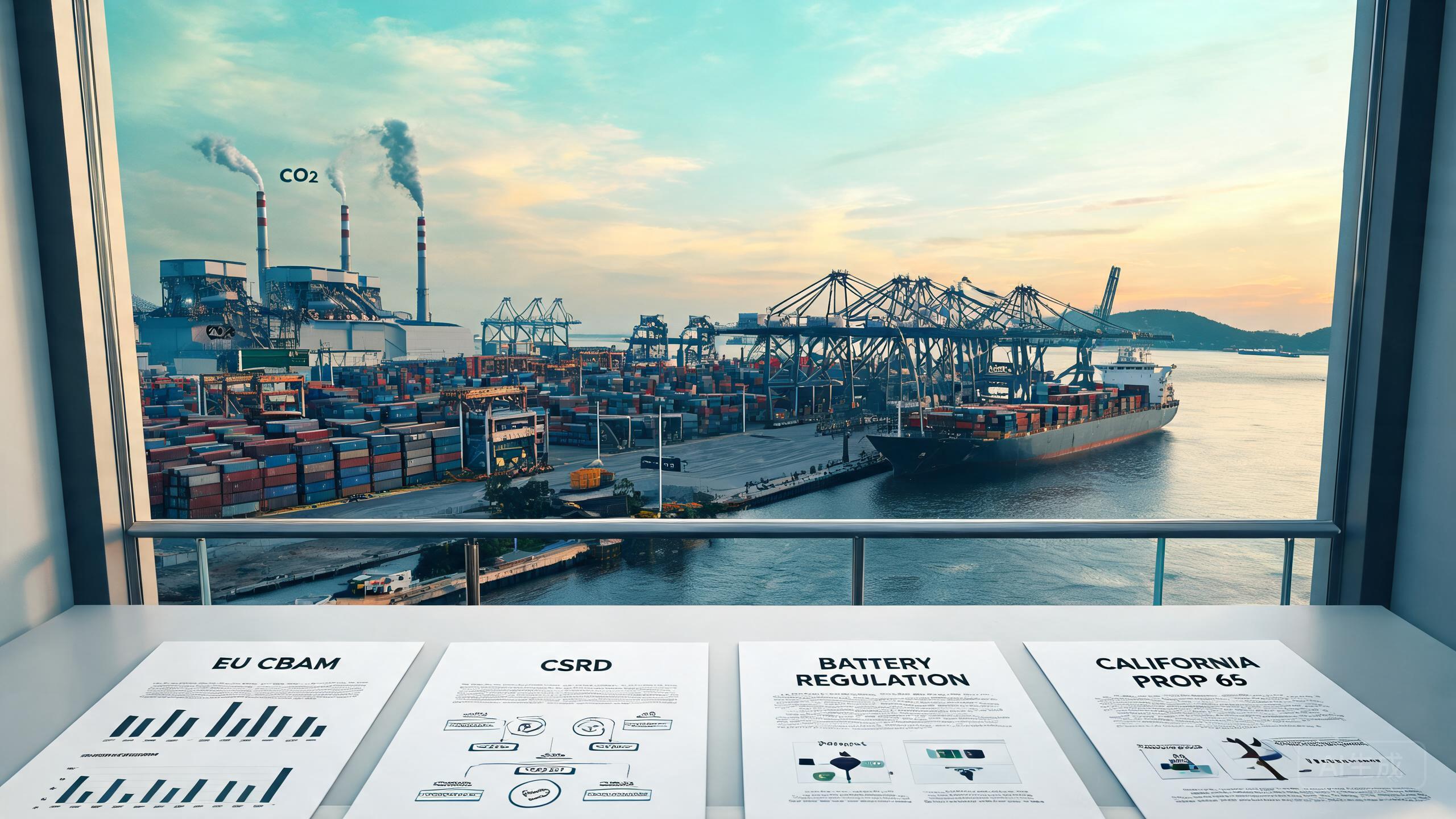
Eco (environmental) regulations are laws that impose environmental obligations on products, their supply chains, or the companies that sell them. Unlike voluntary eco certifications, these are mandatory — non-compliance leads to customs refusal, fines, or product recalls. For China importers, the regulations that matter most are in the destination market (EU and US), but China's own environmental enforcement also affects factory availability and cost. The key regulations are EU CBAM (carbon border tax), EU CSRD (sustainability reporting), EU Battery Regulation (battery passport), EU Packaging Regulation (recycled content), California Prop 65 (chemical warnings), US TSCA (chemical substances), and China's dual carbon goals. See also product certifications and eco certifications.
Regulation Comparison Table
| Regulation | Market | Scope | Key obligation | In force |
|---|---|---|---|---|
| CBAM | EU | Steel, aluminum, cement, fertilizers, electricity, hydrogen | Report embedded carbon; buy certificates at EU carbon price | Transitional 2023-2025; certificates from 2026 |
| CSRD | EU | Large companies (250+ employees, €40M+ revenue) | Sustainability reporting on environment, social, governance | Phased 2025-2029 |
| EU Battery Regulation | EU | All batteries placed on EU market | Battery passport, carbon footprint, recycled content, due diligence | Battery passport from 2027 |
| Packaging & Packaging Waste Regulation | EU | All packaging | Recycled-content targets, recyclable-by-design, EPR | Phased 2025-2040 |
| California Prop 65 | US (CA) | All consumer products | Warning label for listed chemicals above safe harbor | Since 1986 (ongoing) |
| TSCA | US | Chemical substances | Pre-manufacturing notice for new chemicals | Since 1976 (reformed 2016) |
| China dual carbon | China (domestic) | Factories and industry | Emissions permits, energy efficiency, peak 2030 / neutral 2060 | Ongoing enforcement |
EU CBAM — Carbon Border Adjustment Mechanism
CBAM is the EU's carbon border tax. It applies to imports of steel, aluminum, cement, fertilizers, electricity and hydrogen. During the transitional period (2023–2025), importers only reported embedded emissions. From 2026, importers must purchase CBAM certificates equal to the EU carbon price (around €60–€90/tonne CO2) for the embedded emissions of their goods, minus any carbon price already paid in the country of origin (China's national ETS covers only part of industry). For China sourcing, this means you must collect verified embedded-emissions data from your Chinese supplier. If you cannot provide verified data, the EU applies a default (higher) emission factor, making your product more expensive. CBAM declarations are filed quarterly with the European Commission.
EU CSRD — Corporate Sustainability Reporting Directive
CSRD requires large companies operating in the EU to report on sustainability: environmental impact (GHG emissions, water use, waste), social factors (labour practices, human rights in the supply chain), and governance. It applies to EU companies with 250+ employees or €40M+ revenue, and to non-EU companies with EU revenues above €150M. For China sourcing, if you are a non-EU company selling into the EU above the threshold, you may need to report, and you will need supply-chain data from your Chinese suppliers (emissions, labour practices). CSRD uses the European Sustainability Reporting Standards (ESRS). Reporting is phased in from 2025 (financial year 2024) to 2029 depending on company size.
EU Battery Regulation
The EU Battery Regulation (Regulation 2023/1542) applies to all batteries placed on the EU market, including those sourced from China. Key requirements:
- Battery passport — a digital record (accessible via QR code) containing battery composition, carbon footprint, recycled content, and durability data. Required for all batteries above 2 kWh from 2027.
- Carbon-footprint declaration — batteries must declare their carbon footprint per kWh, with maximum limits phased in from 2027.
- Minimum recycled content — 16% cobalt, 85% lead, 6% lithium, 6% nickel by 2031.
- Due diligence — importers must verify that raw materials (cobalt, lithium, nickel) are not sourced from conflict-affected areas.
For China sourcing, any battery you import to the EU must have a battery passport and meet the carbon-footprint and recycled-content rules. Without a battery passport, the battery cannot be placed on the EU market.
EU Packaging and Packaging Waste Regulation
The EU Packaging and Packaging Waste Regulation (PPWR), adopted in 2025, applies to all packaging placed on the EU market, including packaging that accompanies products sourced from China. Key requirements:
- Mandatory recycled content for plastic packaging: 30% by 2030, 50% by 2040.
- Bans on certain single-use packaging formats (e.g. mini shampoo bottles in hotels, thin plastic carrier bags, unnecessary packaging).
- Recyclable by design — all packaging must be recyclable in practice by 2030.
- Extended Producer Responsibility (EPR) — producers pay for collection and recycling.
For China sourcing, any packaging (retail box, polybag, carton) you ship to the EU must meet the recycled-content targets and be properly labeled for recycling. Non-compliant packaging is refused at EU customs or faces EPR fines.
California Prop 65
Proposition 65 is a California law requiring businesses to provide a clear warning before exposing Californians to chemicals known to cause cancer, birth defects or reproductive harm. It applies to virtually all consumer products sold in California, including those sourced from China. The list contains over 900 chemicals, including lead, cadmium, phthalates (DEHP, BBP, DBP), BPA, and formaldehyde. If your product contains a listed chemical above the safe harbor level, you must display a Prop 65 warning on the product and packaging. Non-compliance can result in fines up to $2,500 per violation per day, plus private-enforcement lawsuits ("bounty hunter" lawsuits). For China sourcing, you need a substance declaration from your factory and, if needed, a lab test to confirm whether a Prop 65 warning is required.
China's Dual Carbon Goals & Factory Enforcement
China's dual carbon goals are: carbon emissions peak before 2030, and carbon neutrality before 2060. To achieve this, China is tightening environmental enforcement on factories: closing high-polluting facilities, requiring emissions permits (排污许可证), limiting high-energy-consumption production, and pushing manufacturers to switch to renewable energy. For importers, this has three practical effects:
- Some Chinese factories may face production limits or energy rationing during enforcement campaigns (especially in winter heating season).
- Suppliers without valid environmental permits may be shut down suddenly, leaving your order unfulfilled.
- Factories investing in clean energy may charge a small green premium, but they are more stable long-term partners.
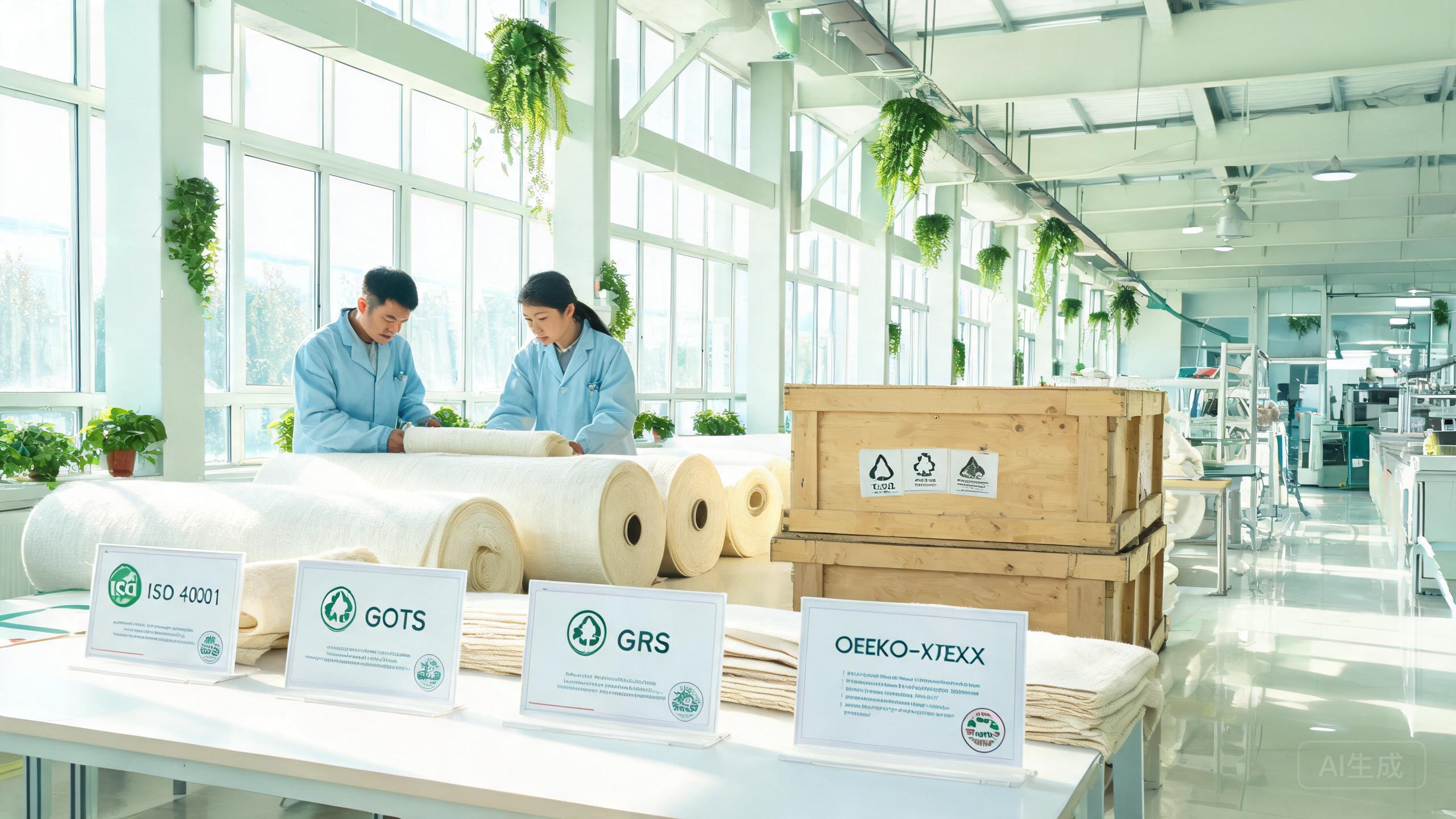
Always verify your supplier has a valid 排污许可证 (pollutant discharge permit) and an environmental impact assessment (EIA) approval before placing a bulk order. ISO 14001 certification is a good supplementary indicator.
Compliance Timeline & Key Dates
| Year | Regulation milestone | Action for China importers |
|---|---|---|
| 2026 | CBAM certificate purchases begin | Collect verified embedded-emissions data from Chinese suppliers for CBAM goods |
| 2027 | Battery passport mandatory for batteries >2 kWh | Ensure all batteries imported to EU have a battery passport and carbon-footprint declaration |
| 2030 | China carbon peak; EU 30% recycled plastic packaging | Switch to suppliers with valid environmental permits; use recycled-content packaging |
| 2031 | EU battery recycled-content targets (16% Co, 6% Li, 6% Ni) | Source batteries meeting recycled-content thresholds |
| 2040 | EU 50% recycled plastic packaging target | Long-term packaging material planning |
| 2060 | China carbon neutrality goal | Long-term supply-chain decarbonization planning |
Worked Example: Aluminum Extrusion to the EU Under CBAM
A buyer sourced 10 tonnes of aluminum extrusion from a factory in Foshan for the EU market. The factory quoted $2,400/tonne FOB. Under CBAM, the buyer must declare the embedded carbon emissions of the aluminum and purchase CBAM certificates. Data and costs:
- Factory-provided embedded emissions: 8.5 t CO2 per tonne of aluminum (verified by a third party)
- EU carbon price (2026 estimate): €75/tonne CO2
- CBAM certificates needed: 10 t × 8.5 = 85 t CO2
- CBAM cost: 85 × €75 = €6,375 (≈ $6,800)
- CBAM cost per tonne: $680
The CBAM certificate adds $680/tonne to the cost of the aluminum — a 28% increase over the $2,400 FOB price. If the buyer could not provide verified emissions data, the EU would apply the default factor (12 t CO2/tonne), raising the CBAM cost to $960/tonne (40% increase). The buyer filed the CBAM quarterly declaration with the European Commission and retained the factory's emissions verification report for 5 years.
How to Comply: 6-Step Checklist
- Map regulations to your product and market. List every regulation that applies (CBAM for steel/aluminum, Battery Regulation for batteries, Prop 65 for California sales, Packaging Regulation for EU).
- Collect supplier data. Ask the Chinese factory for embedded-emissions data (CBAM), material composition (packaging, battery), substance declarations (Prop 65, REACH, TSCA), and test reports.
- Verify data where required. CBAM emissions should be verified by a third party. Prop 65 chemical content may need lab testing. Battery passport data comes from the battery manufacturer.
- File declarations on time. CBAM quarterly, battery passport at point of sale, Prop 65 warning on the product. Late filing delays customs clearance.
- Budget for compliance costs. CBAM certificates, battery passport IT systems, lab testing, EPR fees — add 5-15% to the landed cost for regulated products.
- Monitor regulatory updates. CBAM expands to more sectors, packaging targets tighten, Prop 65 list grows. Track changes at least quarterly.
Common Red Flags
- Chinese factory refuses to provide embedded-emissions data for CBAM goods — you will pay the higher default factor.
- Battery supplier cannot produce a battery passport — the battery cannot be sold in the EU from 2027.
- Product sold in California with no Prop 65 warning and no substance test — risk of $2,500/day fines and private lawsuits.
- Factory without a valid 排污许可证 (pollutant discharge permit) — risk of sudden shutdown mid-order.
- Packaging that does not meet EU recycled-content targets — refused at EU customs.
How Yeatru Helps
- Map your product and destination market to the applicable environmental regulations before you place an order.
- Collect and verify supplier data: embedded emissions (CBAM), material composition (packaging, battery), substance declarations (Prop 65, REACH, TSCA).
- Arrange accredited-lab testing for chemical content, emissions, and material composition where required.
- Verify the factory's environmental permits (排污许可证, EIA) to reduce supply-chain disruption risk.
- Coordinate the documentation needed for customs declarations (CBAM, battery passport, Prop 65 warning labels).
Frequently Asked Questions
1. What environmental regulations affect sourcing from China?
The main regulations are: EU CBAM (Carbon Border Adjustment Mechanism) requiring embedded-carbon reporting for steel, aluminum, cement, fertilizers, electricity and hydrogen; EU CSRD (Corporate Sustainability Reporting Directive) requiring sustainability disclosures; EU Battery Regulation requiring battery passports and carbon-footprint declarations; EU Packaging and Packaging Waste Regulation setting recycled-content targets; California Prop 65 requiring warnings for listed chemicals; and US TSCA for chemical substances. China's own rules include the dual carbon goals (carbon peak 2030, neutrality 2060).
2. What is CBAM and how does it affect China imports?
CBAM (Carbon Border Adjustment Mechanism) is the EU's carbon border tax. It applies to imports of steel, aluminum, cement, fertilizers, electricity and hydrogen. Importers must report the embedded carbon emissions of their goods and, from 2026, purchase CBAM certificates equal to the EU carbon price for those emissions. For China sourcing, this means you must collect verified embedded-emissions data from your Chinese supplier or use the default (higher) emission factor, which makes your product more expensive in the EU.
3. What is the EU Battery Regulation?
The EU Battery Regulation (Regulation 2023/1542) applies to all batteries placed on the EU market. It requires: a battery passport (digital record accessible via QR code) for all batteries above 2 kWh from 2027; a carbon-footprint declaration; minimum recycled-content levels (16% cobalt, 85% lead, 6% lithium, 6% nickel by 2031); and due-diligence for raw materials. For China sourcing, this means any battery you import to the EU must have a battery passport and meet the recycled-content and carbon-footprint requirements.
4. What is California Prop 65?
Proposition 65 (Safe Drinking Water and Toxic Enforcement Act of 1986) is a California law requiring businesses to provide a clear warning before exposing Californians to chemicals known to cause cancer, birth defects or reproductive harm. It applies to virtually all consumer products sold in California, including those sourced from China. If your product contains a listed chemical (e.g. lead, cadmium, phthalates, BPA) above the safe harbor level, you must display a Prop 65 warning. Non-compliance can result in fines up to $2,500 per violation per day.
5. What is the EU Packaging and Packaging Waste Regulation?
The EU Packaging and Packaging Waste Regulation (PPWR, adopted 2025) sets mandatory recycled-content targets for plastic packaging (30% by 2030, 50% by 2040), bans certain single-use packaging formats (e.g. mini shampoo bottles, thin plastic bags), requires packaging to be recyclable by design, and introduces extended producer responsibility (EPR) fees. For China sourcing, any packaging you ship with your product to the EU must meet these targets and be properly labeled for recycling.
6. What are China's dual carbon goals?
China's dual carbon goals are: carbon emissions peak before 2030, and carbon neutrality before 2060. To achieve this, China is tightening environmental enforcement on factories — closing high-polluting facilities, requiring emissions permits, and pushing manufacturers to switch to renewable energy. For importers, this means some Chinese factories may face production limits, energy rationing or higher costs during enforcement campaigns. Always confirm your supplier has valid environmental permits (排污许可证) before placing a bulk order.
Common Pitfalls to Avoid
- Ignoring CBAM for CBAM-covered goods. Steel, aluminum, cement, fertilizers, electricity and hydrogen imported to the EU are covered. Without verified emissions data you pay the higher default factor, eroding your margin.
- No battery passport for EU battery sales. From 2027, any battery above 2 kWh without a battery passport cannot be placed on the EU market. This blocks your entire product line.
- Missing Prop 65 warnings in California. Selling a product with a listed chemical and no warning exposes you to $2,500/day fines plus private-enforcement lawsuits. A single product can generate thousands in penalties.
- Non-compliant packaging for the EU. Packaging that fails the recycled-content or recyclable-by-design rules is refused at customs — your goods are stranded at the port.
- Not verifying factory environmental permits. A factory without a valid 排污许可证 can be shut down overnight, leaving your order unfulfilled and your deposit at risk.
Conclusion
Environmental regulations for China sourcing are mandatory and growing: EU CBAM (carbon reporting for steel, aluminum and more), EU Battery Regulation (battery passport from 2027), EU Packaging Regulation (recycled-content targets), California Prop 65 (chemical warnings), and China's dual carbon goals (factory enforcement). The common thread is data collection from your Chinese supplier — embedded emissions, material composition, substance declarations, environmental permits. Without that data you cannot file the required declarations, and you face customs refusal, fines, or product bans. Map your product to the applicable regulations before you order, collect verified supplier data, file declarations on time, and monitor regulatory updates. Ask Yeatru to map your product to the required environmental regulations before you place an order. Related: eco certifications for China sourcing and China product certifications guide.