What Is AQL 2.5 Inspection?
AQL (Acceptable Quality Limit) is the maximum percentage of defective units that can be present in a sample and still allow the whole lot to be considered acceptable, defined by the international standard ISO 2859-1 (US equivalent ANSI Z1.4). AQL 2.5 means a defect rate of 2.5% is the agreed acceptable level for major defects. It is the most widely used AQL in China sourcing and underpins almost every pre-shipment inspection (PSI) and during-production inspection (DUPRO).
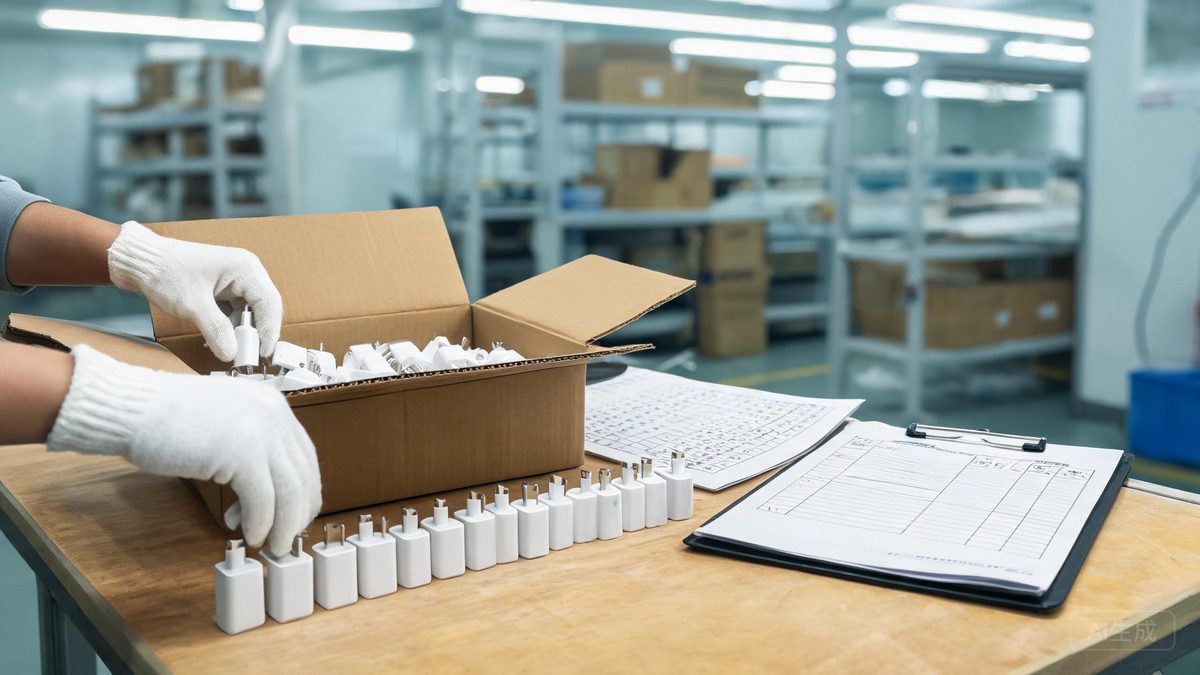
AQL sampling is statistical, not 100% inspection: you pull a representative sample, count defects by class, and compare the counts against the Accept (Ac) and Reject (Re) numbers from the AQL table. If any defect class reaches Re, the lot fails inspection.
AQL Levels and When to Use Each
AQL values run from 0 (zero tolerance) up to 10 or higher. The five levels most buyers encounter for China-sourced consumer goods are 0.4, 1.0, 2.5, 4.0, and 6.5. Lower numbers = stricter tolerance = more defects rejected. The right level depends on the product's value, safety risk, and defect type.
| AQL Level | Defect Type | Typical Use Case | Product Examples |
|---|---|---|---|
| 0 | Critical | Safety hazards — zero tolerance, one defect fails the lot | Choking parts on toys, live electrical contacts, toxic paint |
| 0.4 / 0.65 | Major (tight) | Regulated / high-value products where defects are costly | Medical devices, baby products, electronics with safety certification |
| 1.0 | Major (strict) | Premium brands, first orders from new suppliers | Brand apparel, smart electronics, high-end home goods |
| 2.5 | Major (standard) | Default for most consumer-goods sourcing from China | Kitchenware, general electronics, toys, most Amazon FBA products |
| 4.0 | Minor (standard) | Cosmetic / minor defects that don't affect function | Small scratches, slight color variation, minor packaging dents |
| 6.5 | Minor (loose) | Low-cost commodities where minor blemishes are expected | Budget tools, bulk promotional items, low-margin hardware |
Note that a single order typically uses multiple AQL levels at once: AQL 0 for critical, AQL 2.5 for major, and AQL 4.0 for minor. Each defect class is counted and judged against its own Ac/Re pair.
Inspection Levels I, II, III — How Many Samples?
The General Inspection Level (I, II, or III) controls the sample size, not the acceptable defect rate. Level II is the default; Level I uses about half as many samples (faster, cheaper, less confidence); Level III uses roughly 1.5× the samples (more scrutiny, higher cost).
| Lot Size | Level I (n) | Level II (n) | Level III (n) | AQL 2.5 Major Ac/Re (Level II) |
|---|---|---|---|---|
| 91 – 150 | 8 | 20 | 32 | 1 / 2 |
| 151 – 280 | 13 | 32 | 50 | 2 / 3 |
| 281 – 500 | 20 | 50 | 80 | 3 / 4 |
| 501 – 1,200 | 32 | 80 | 125 | 5 / 6 |
| 1,201 – 3,200 | 50 | 125 | 200 | 7 / 8 |
| 3,201 – 10,000 | 80 | 200 | 315 | 10 / 11 |
| 10,001 – 35,000 | 125 | 315 | 500 | 14 / 15 |
The numbers above are the single-sampling plan for AQL 2.5 major defects under ISO 2859-1. The same sample size n is used for all defect classes, but each class reads its own Ac/Re from its own AQL column. For example, with lot size 2,000 (Level II, n=125): AQL 2.5 major → Ac=7 / Re=8; AQL 4.0 minor → Ac=10 / Re=11.
How to Read the AQL Table: 4 Steps
- Find your lot size — e.g. 2,000 units — and your inspection level (default II). The intersection gives a sample-size code letter (K for 1,201–3,200 at Level II).
- Look up the sample size n — code letter K = 125 samples.
- Choose AQL columns by defect class — e.g. AQL 0 for critical, 2.5 for major, 4.0 for minor.
- Read Ac/Re — on the row for n=125, AQL 2.5 column shows Ac=7, Re=8; AQL 4.0 shows Ac=10, Re=11.
If the cell shows an arrow (↑ or ↓), follow the arrow to the first Ac/Re pair and use the corresponding sample size — the standard "alternate sample size" rule. Always use the same Ac/Re row for all defect classes unless the table forces an alternate size.
Defect Types: Critical, Major, Minor
Every defect must be classified before counting. For full definitions and category examples, see our defect classification guide. In short:
- Critical (AQL 0) — safety hazards: choking, electrical shock, fire, sharp edges, toxic materials. One critical defect fails the whole lot.
- Major (AQL 2.5) — functional failure, wrong color/size, broken parts, wrong labeling, missing components. Affects saleability or function.
- Minor (AQL 4.0) — cosmetic scratches, small packaging defects, slight color variation. Doesn't affect function or saleability.
Worked Example: 3,000-Unit Order, AQL 2.5 Major / 4.0 Minor
An Amazon FBA buyer orders 3,000 silicone kitchen utensils at $3.20/unit. The contract specifies AQL 0 critical / 2.5 major / 4.0 minor, General Inspection Level II.
- Lot size 3,000 → Level II → code letter L → sample size n = 200
- AQL 2.5 major: Ac = 10, Re = 11
- AQL 4.0 minor: Ac = 14, Re = 15
- AQL 0 critical: Ac = 0, Re = 1
The inspector pulls 200 units and finds 1 critical (a loose steel blade edge) and 12 major (wrong logo print position) defects.
Result: FAIL. Critical count (1) ≥ Re (1) — lot fails immediately on the critical defect alone. Major count (12) ≥ Re (11) also fails the major class. The supplier must rework the lot and pass a re-inspection before the buyer releases the balance payment.
When to Use Each AQL Level
- AQL 0.4 / 0.65 — baby products, medical devices, food-contact items, products requiring CE/FCC/CPC certification where defects trigger recalls.
- AQL 1.0 — premium private-label brands, first orders from an unproven supplier, high-ticket electronics.
- AQL 2.5 (default) — most Amazon FBA, wholesale, and retail consumer goods. Standard for pre-shipment inspection.
- AQL 4.0 — minor defects only; always paired with a stricter major AQL on the same order.
- AQL 6.5 — low-cost promotional items, giveaways, commodities where minor blemishes don't affect the sale.
How to Negotiate AQL with Your Supplier
AQL is a contractual term, not a fixed rule. Negotiate it before mass production:
- Write AQL into the PO/contract — specify AQL 0/2.5/4.0 for critical/major/minor, inspection level (II), and who pays for re-inspection after a failure.
- Provide a defect-specification sheet — list exactly which defects are critical/major/minor for your product, with photos. Disputes at inspection time usually come from undefined defects, not from the AQL table itself.
- Trade AQL for price — demanding AQL 1.0 instead of 2.5 may add a 2–5% unit price premium. Accept the premium for high-value products; for commodities, 2.5 is enough.
- Agree on failure handling — rework + re-inspection at supplier cost is standard. Avoid "accept with discount" for safety-critical defects.
How Yeatru Applies AQL 2.5 Inspections
Yeatru's QC team runs AQL 2.5 major / 4.0 minor / 0 critical as the default on every pre-shipment inspection and during-production inspection. We provide:
- A customized defect-specification sheet per product, agreed with you before production
- Photo and video evidence for every defect found (see QC photo & video evidence)
- Same-day inspection report with defect counts by class, Ac/Re comparison, and a clear Pass/Fail decision
- Re-inspection after supplier rework, billed to the supplier per your contract
Frequently Asked Questions
1. What is AQL 2.5 inspection?
AQL 2.5 is the Acceptable Quality Limit allowing up to 2.5% major defects under ISO 2859-1 / ANSI Z1.4. The inspector pulls a statistically sized sample, counts major defects, and compares against the Ac/Re numbers for the AQL 2.5 column. It is the standard major-defect level for most China-sourced consumer goods.
2. Is AQL 2.5 strict?
AQL 2.5 is the industry middle ground — balanced, not overly strict. Tighter levels (1.0, 0.65, 0.4) are used for regulated, high-value, or safety-critical products. Looser levels (4.0, 6.5) are used for minor defects or low-cost commodities. Critical defects always use AQL 0 (zero tolerance).
3. How many samples do I inspect for 1,000 units under AQL 2.5?
1,000 units under Level II → code letter J → 80 samples. AQL 2.5 major: Ac=5, Re=6. AQL 4.0 minor: Ac=7, Re=8. Inspect 80 units; reject if 6+ major or 8+ minor defects are found.
4. Can I negotiate AQL with my supplier?
Yes. AQL is negotiable and should be in the contract before production. Tighter AQL (e.g. 1.0 instead of 2.5) may add a 2–5% unit-price premium. Provide a defect-spec sheet and agree on who pays for re-inspection after failure.
5. What if the AQL inspection fails?
Failure means a defect count reaches Re. Options: supplier reworks + re-inspects at their cost (standard); accept with a price discount; reject and refund; or sort-and-replace defective units. The re-inspection report gates the balance payment.
6. AQL sampling vs 100% inspection — which should I use?
AQL sampling inspects a representative sample (e.g. 80 of 1,000) and is the cost-effective standard. 100% inspection checks every unit and is used for safety-critical products, small lots, or lots that already failed AQL. AQL costs $80–$300/man-day; 100% costs 2–5× more.
Conclusion
AQL 2.5 is the backbone of quality control in China sourcing — a statistically sound, internationally standardized way to decide whether a lot ships without inspecting every unit. The key to using it well is pairing the right AQL levels by defect class (0 critical / 2.5 major / 4.0 minor), choosing the right inspection level (II by default), and defining your defect specification sheet before production. When counts hit Re, trigger rework and re-inspection — never release the balance payment on a failed lot. Contact Yeatru to set up AQL 2.5 inspections for your next order, with photo evidence and same-day reports.