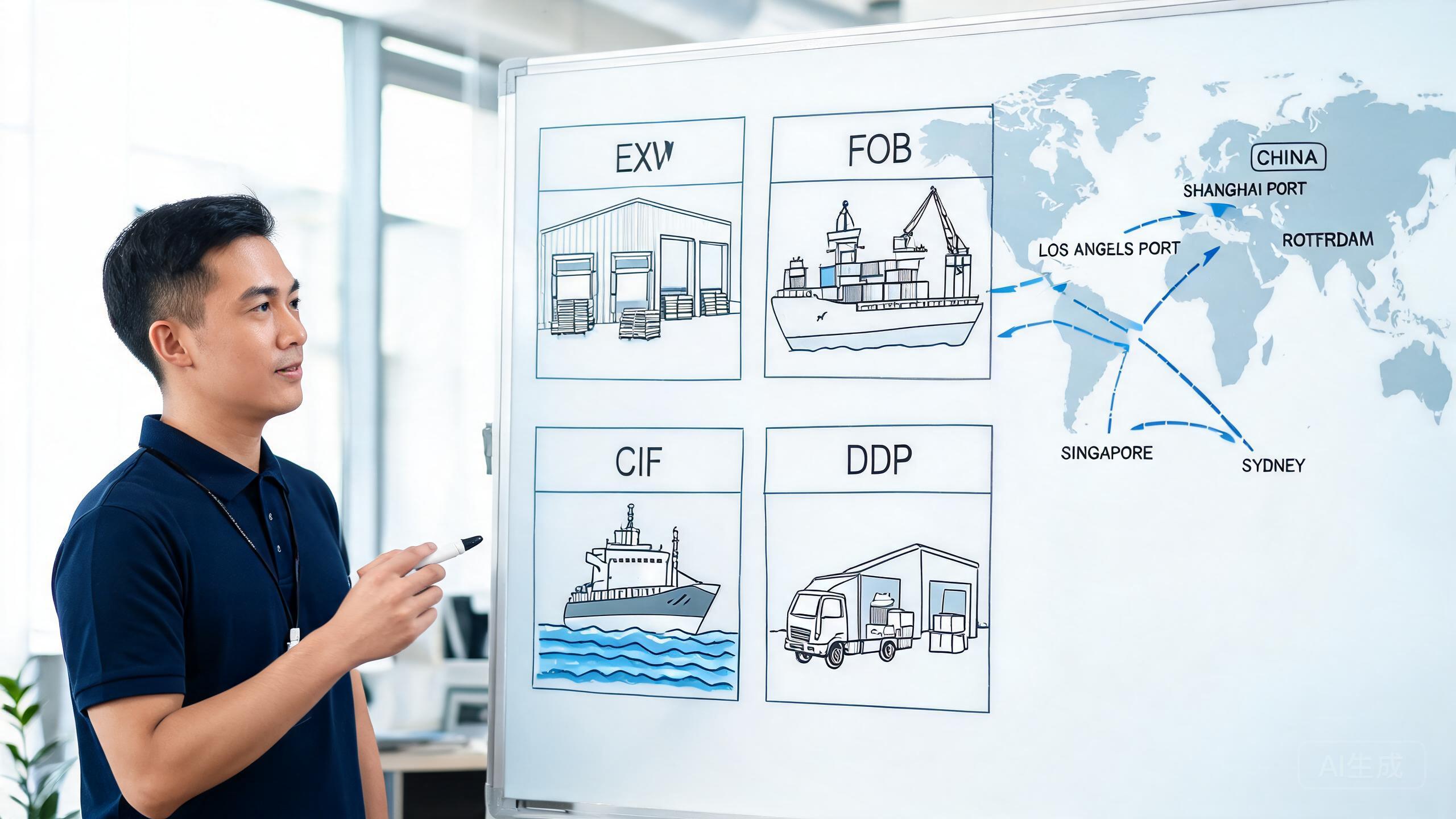
What Does DDU Mean, and How Does It Differ From DDP?
DDU (Delivered Duty Unpaid) and DDP (Delivered Duty Paid) are both door-to-door shipping arrangements. Under either one the seller arranges export clearance in China, international freight, insurance, and delivery to the buyer's address. The one difference is import customs clearance and import duty: with DDU the buyer clears customs and pays the duty; with DDP the seller does both.
The catch is the name itself. DDU was dropped when Incoterms 2020 took effect. It is not one of the eleven current rules. Its replacement is DAP (Delivered at Place), which is functionally identical: seller delivers to your door, buyer pays duty. So when a Chinese supplier emails "DDU New York", they mean "DAP New York". If they email "DDP New York", the seller is taking on duty and clearance. That single word — Paid vs Unpaid — is the entire DDU vs DDP decision.
DDU vs DDP: Side-by-Side Comparison
| Responsibility | DDU (= DAP, Delivered Duty Unpaid) | DDP (Delivered Duty Paid) |
|---|---|---|
| Export clearance (China) | Seller | Seller |
| International freight | Seller | Seller |
| Insurance | Seller (recommended) | Seller (recommended) |
| Delivery to buyer's door | Seller | Seller |
| Import customs clearance | Buyer | Seller |
| Import duty & VAT | Buyer | Seller |
| Importer of record | Buyer | Seller / their forwarder |
| Risk transfer point | Buyer's premises | Buyer's premises |
| Buyer admin | Must file entry & pay duty | None — door-to-door done |
| Status in Incoterms 2020 | Retired name for DAP (use DAP) | Valid rule (current) |
The Duty Difference: A Worked Example
Take a 1,000-unit order of silicone kitchen tools at $4.00/unit EXW Yiwu, shipped by sea to Los Angeles. Freight, insurance and last-mile to door are identical under both terms at $1.20/unit. The only variable is import duty and clearance.
| Line Item | DDU / DAP | DDP |
|---|---|---|
| Goods + freight + insurance + last-mile | $5.20/unit | $5.20/unit |
| US customs entry + bond + ISF | $0.18/unit (buyer) | $0.22/unit (seller markup) |
| HTS duty (say 3.9% on $4.00 goods) | $0.16/unit (buyer pays) | $0.18/unit (seller bundles + markup) |
| Section 301 tariff (if applicable, 25%) | $1.00/unit (buyer pays) | $1.10/unit (seller bundles + margin) |
| Total landed per unit | $6.54 (duty separate) | $6.70 (all-in) |
DDP lands about $0.16/unit higher because the seller adds a 10%–15% margin on the duty and clearance line. On a 1,000-unit order that is roughly $160 more. But under DDU/DAP you must have a US customs broker, file the entry and pay the duty out of pocket — for this order about $1,340 before the goods are released. Which term is "cheaper" therefore depends on your cash flow and whether you already have a broker.
When to Choose DDU / DAP
- You already have a customs broker in the destination country with your bond on file — they clear faster and often cheaper than the seller's broker.
- You qualify for duty-deferral or exemption programs (US Foreign Trade Zone, EU inward processing relief, duty drawback). Under DAP you claim these directly; under DDP the seller charges standard duty and keeps the benefit.
- High-duty goods where a 10%–15% seller margin on duty is material — Section 301 categories, for example.
- Experienced, high-volume importers who want full visibility of the duty line and can absorb the admin.
When to Choose DDP
- First-time importers and small orders — one all-in price, no customs paperwork, no surprise duty invoice.
- No customs broker in the destination country — the seller's forwarder clears everything.
- Amazon FBA and tight restock windows — DDP avoids customs delays that would miss an FBA window.
- Low-duty or duty-free goods where the seller's markup on duty is negligible (many textiles sit at 0%–3%).
DDU, DAP and DDP: The Names in 2026
The three door-to-door labels, ranked by how much the buyer has to do:
- DDP — seller pays duty and clears customs. Simplest for the buyer; one all-in price.
- DAP (formerly DDU) — buyer pays duty and clears customs. Slightly cheaper on the duty line, but needs a broker.
- CIF / CIP — not door-to-door: the seller delivers to the destination port; the buyer handles inland freight, duty and delivery.
If a supplier uses "DDU" simply because it is the wording they learned years ago, do not treat that as a red flag — just restate it as DAP. Treat it as a red flag only if they refuse to say who pays duty.
How Yeatru Quotes DDU/DAP and DDP
Yeatru provides both terms side by side so the trade-off is transparent:
- DDP quotes include a verified duty breakdown — HS code, duty rate, and Section 301 status where applicable — so the all-in price is auditable.
- DAP (DDU) quotes leave duty off the invoice; we can work with your destination broker or recommend an audited one.
- We use established forwarders rather than cheap DDP brokers that misdeclare HS codes, which is where most "surprise duty" disputes start.
Frequently Asked Questions
1. What is the difference between DDU and DDP?
Only one thing differs: import duty and customs clearance. Under DDU (now DAP) the buyer clears customs and pays import duty; under DDP the seller clears customs and pays import duty. Freight, insurance, export clearance and delivery to your door are identical.
2. Is DDU the same as DAP?
Yes. DDU (Delivered Duty Unpaid) was an Incoterms 2000/2010 term and was renamed DAP (Delivered at Place) in Incoterms 2020. If a supplier quotes DDU in 2026, treat it as DAP and confirm who pays import duty.
3. Is DDU still used in Incoterms 2020?
No. DDU is not one of the eleven Incoterms 2020 rules; it was replaced by DAP. The name survives only in everyday trade talk and on older supplier templates, which is why it still causes confusion.
4. Is DDU or DDP cheaper for the buyer?
DDU (DAP) is usually cheaper on the duty line because DDP quotes bundle a 10%–15% seller margin on duty and clearance. But DDU requires a customs broker and upfront duty payment, which affects cash flow. For low-duty goods the DDP markup is small and DDP's simplicity wins.
5. Who is the importer of record under DDU versus DDP?
Under DDU (DAP) the buyer is importer of record. Under DDP the seller (or their forwarder) is importer of record. Even so, the end buyer stays responsible for a correct HS classification; if the seller's broker misdeclares, the buyer can be held liable for the shortfall.
6. Can I ask my Chinese supplier to quote DDU instead of DDP?
You can, but the correct modern wording is DAP. Ask for a DAP quote to your named place with duty excluded. If the supplier cannot back a DDP quote with an HS code and duty breakdown, switch to DAP and clear with your own broker.
Conclusion
DDU and DDP both deliver to your door — the only difference is who pays import duty, and DDU is simply the old name for DAP. Choose DDP for simplicity, especially on first or small orders and when you have no customs broker. Choose DDU/DAP when you have your own broker, qualify for duty-deferral programs, or import high-duty goods where the seller's DDP margin matters. Whichever you pick, restate the term in current Incoterms 2020 wording and demand an HS code and duty breakdown on any DDP price. Request a DDU vs DDP comparison quote from Yeatru with full duty transparency.