Trading Company vs Sourcing Agent: When Each Wins
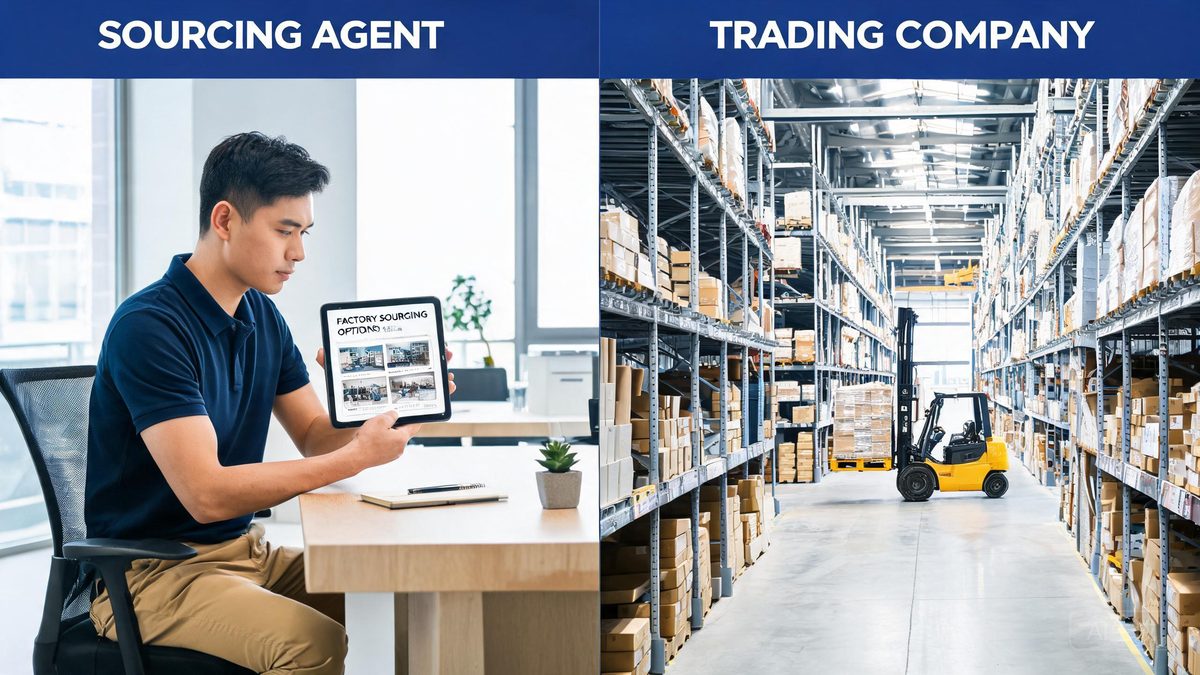
A trading company buys goods from one or more factories, takes ownership, and resells them to you with a 10-30% markup baked into the price. A sourcing agent never owns the goods — it works on your behalf, finds the real factory, charges a transparent 3-8% fee, and discloses the factory on the proforma invoice. This guide focuses on when each model wins; for the full field-by-field breakdown see our sourcing agent vs trading company guide.
The 8-Axis Comparison
Eight axes decide which partner fits your order. A trading company and an agent sit on opposite sides of most of them.
| Axis | Trading Company | Sourcing Agent |
|---|---|---|
| Who they work for | Itself (resells at a margin) | You (buyer-side, fee-based) |
| Pricing transparency | Markup hidden in unit price | Factory cost + visible 3-8% fee |
| Factory disclosure | Often hidden (to protect its margin) | Disclosed on PI |
| Fee model | 10-30% spread, invisible | 3-8% commission or flat fee |
| QC accountability | Conflicted (owns the goods) | Independent AQL 2.5, liable to you |
| IP protection | Limited; molds stay with its factory | NDA + mold ownership to buyer |
| MOQ flexibility | Low (consolidates many buyers) | Negotiable 20-50% down at the factory |
| After-sales | Contractual only, slow | Agent owns the relationship, faster |
How to Tell Which One You Are Dealing With
Three checks expose the real business model behind any "factory" quote:
- Business license scope (经营范围) — pull the license on gsxt.gov.cn. A factory's scope lists 生产 (production); a trading company's lists 贸易 (trade); an agent's lists 代理 or 服务 (agency/service).
- PI factory-name disclosure — ask the supplier to name the actual manufacturer on the proforma invoice. A trading company resists; an agent provides it and bills its fee on a separate line.
- Factory visit or video tour — request a live walk-through of the production line with today's date. A real factory agrees; a trading company deflects or sends stock footage.
When a Trading Company Actually Wins
Trading companies are not a trap — for the right order they are the cheaper, simpler choice:
- Small mixed orders — 5-15 SKUs from different factories, total under $5,000. A trading company consolidates them into one shipment and one invoice, sparing you five supplier relationships.
- No factory bandwidth — you have no China team and want one English-speaking contact who handles export docs, consolidation, and after-sales.
- Sample consolidation — collecting samples from 8-10 factories for a product-research sprint; a trading company bundles them cheaply.
- Stock catalog goods — off-the-shelf Yiwu items where customization and IP are irrelevant.
When a Sourcing Agent Wins
An agent is the better fit when control, IP, or compliance matter more than a single invoice:
- Private-label / OEM — custom molds, packaging, and logos require direct factory coordination and documented mold ownership.
- IP-sensitive designs — an agent signs an NDA and registers artwork and tooling to you, not the factory.
- Compliance-heavy goods — electronics, toys, and medical items need CE, FCC, RoHS, or REACH test reports tied to the real factory.
- Volume orders above $5,000 — the agent's factory-direct price plus 3-8% usually beats the trading company's marked-up price by 8-20% landed.
Decision Matrix: 3 Buyer Profiles
Three real profiles, mapped to the partner that wins and why.
| Profile | Order | Winner | Why |
|---|---|---|---|
| Small mixed buyer | 8 SKUs, $4,000, off-the-shelf home goods | Trading company | Consolidates 8 factories, low MOQ, one shipment; agent's 5% fee ($200) not justified |
| Private-label apparel | 1 SKU, 3,000 units, custom logo + woven labels, $30,000 | Sourcing agent | Factory disclosure for private-label, IP/mold ownership, AQL QC, factory-direct price |
| Compliance electronics | 2 SKUs, 2,000 units, CE/RoHS/REACH required, $45,000 | Sourcing agent | Handles test reports + factory audit + AQL QC; a trading company may swap factories and lose the compliance trail |
Worked Example: $30,000 Private-Label Order
Profile 2 in numbers — 3,000 units of private-label apparel, EXW China, shipped DDP to the US.
| Cost line | Trading company | Sourcing agent (5%) |
|---|---|---|
| Unit cost (EXW) | $11.50 (10-30% markup) | $9.80 (factory-direct) |
| Goods total (3,000 units) | $34,500 | $29,400 |
| Agent fee (5%) | $0 | $1,470 |
| Pre-shipment QC (AQL 2.5) | $0 (skipped) | $300 |
| Freight DDP | $3,200 | $3,200 |
| US duty (7.5%) | $2,588 | $2,205 |
| Defect rework (5% of units) | $1,725 | $0 (caught at QC) |
| Total landed cost | $42,013 | $36,575 |
The agent saves $5,438 (13%) even after its 5% fee, because the trading-company markup on unit price compounds through duty and defect rework. For the small mixed profile the math reverses: the trading company's consolidation beats paying 5% on a $4,000 order.
How Yeatru Helps You Pick the Right Partner
Yeatru Sourcing operates as a buyer-side agent but is candid about when a trading company is the cheaper call:
- We verify the license and disclose whether each candidate is a factory, trading company, or agent.
- For small mixed orders we refer buyers to vetted trading companies that consolidate cleanly.
- For private-label, IP-sensitive, and compliance orders we run the full agent model: factory-direct pricing, AQL 2.5 QC, NDA + mold ownership, and DDP shipping.
- Compare this against Alibaba vs sourcing agent and what a sourcing agent is to see the full landscape.
Frequently Asked Questions
1. Is a trading company bad?
No. A good trading company consolidates small orders from many factories, handles export docs, and accepts low MOQs a factory would refuse. They become a problem only when they pose as a factory, hide markups, or block factory access for a buyer who needs private-label control.
2. How do I tell a sourcing agent from a trading company?
Check who invoices you and what the business license says. A trading company sells you goods (owns inventory, markup in price, license scope is 贸易). An agent sells you a service (transparent 3-8% fee, factory disclosed on the PI, license scope is 代理/服务). Ask for the factory name and a video tour.
3. Does a trading company mark up the price?
Yes, typically 10-30% over the factory price, embedded in the unit price so it is invisible. A sourcing agent instead charges an explicit 3-8% fee on top of the factory price, which you can see on the factory PI.
4. Can a trading company do QC?
Some do, but their incentive is conflicted: they own the goods and profit from shipping them. Independent AQL 2.5 pre-shipment inspection by your agent (or SGS/TUV) is more reliable because the inspector answers to you, not the seller.
5. Which is cheaper, trading company or sourcing agent?
For a single small order a trading company can be cheaper because there is no separate fee. For orders above $5,000, multi-SKU, or private-label, the agent's factory-direct price plus 3-8% usually beats the trading company's marked-up price by 8-20% landed.
6. When should I use a trading company vs a sourcing agent?
Use a trading company for small mixed orders, samples, no-factory-bandwidth buys, and stock catalog goods. Use a sourcing agent for private-label, IP-sensitive designs, compliance-heavy electronics or toys, and any order where you need real factory access and on-site QC.
Common Pitfalls to Avoid
- Choosing the cheapest agent without due diligence. Commission below 2% is usually subsidized by factory kickbacks or hidden markups — you pay more in inflated goods cost. A real 3–8% fee with transparency costs less.
- Not verifying the business license. Look up the agent on gsxt.gov.cn (National Enterprise Credit Information). Confirm the business scope lists 代理 (agency), registered capital $50k+, and no abnormal operation status.
- No 3 client references in your category. Ask for 3 buyers who sourced a similar product in the last 6 months and actually call them. Verify delivery, defect rate, and fee transparency.
- Refusing to share the factory name. A reputable agent discloses the factory and lets you pay the factory directly. An agent that hides the factory is marking up the goods price, not just charging a fee.
- No contract with QC and defect-liability terms. Sign an agreement covering NDA, IP protection, QC pass criteria (AQL level), and who pays for rework. A handshake deal leaves you with no recourse.
Conclusion
Trading companies and sourcing agents are not good-vs-bad — they are right-vs-wrong for your order profile. Trading companies win on small mixed orders, sample consolidation, and stock buys where one invoice and low MOQs beat a 3-8% fee. Sourcing agents win on private-label, IP-sensitive, compliance-heavy, and volume orders where factory disclosure, AQL QC, and factory-direct pricing return 8-20% landed. Identify the partner from the business-license scope and the PI, then match the model to your order. Ask Yeatru to verify your next supplier and tell you honestly whether a trading company or an agent fits your order better. Related: how to choose a sourcing agent, sourcing agent fees.